|
|
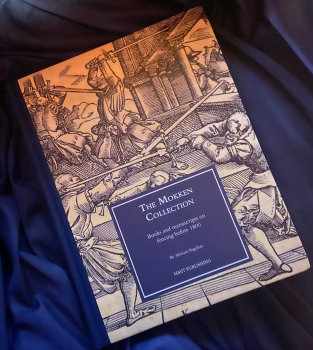 The
Mokken Collection - Books and manuscripts on fencing before
1800 The
Mokken Collection - Books and manuscripts on fencing before
1800
By Miriam Vogelaar
MMIT Publishing, 2020
Reviewed by ARMA Director John Clements
Appreciation for the genre of literature that makes up the
fight-books has grown considerably since the year 2000. Though
systematic study of the books and their teachings began in the
1890s, it did not survive much past 1900. There was a time about
two decades past when serious students of the emerging field
of European martial arts studies were so desperate for access
to the historical source works, and images of quality resolution
from them so rare, that we had to scrounge for photocopies of
photocopies of photocopies. We started to search every possible
venue for fight-books and share them online when possible (this
website among the very first, if not the actual first, to do
so).
But for years, in classes or public exhibitions many of us
were still reliant on displaying portions by printing them out
and putting them in ringed binders or, if we could, sometimes
on tablets. Too many institutions were still being stingy in
hiding this forgotten heritage behind the locked cabinets of
rare book collections. The idea that they were "preserving
them for prosperity" -even as posterity had at last come
knocking at their very door- was still ignored by most of them.
Private collections were even worse in guarding their fight-books
as if they were forbidden secrets to be hidden away in treasure
vaults. Eventually, awareness and demand for them grew so that
many owning institutions were pressured into digitizing them.
Access to more and more of them became available. Finally, by
the first decade of the 2000s, reliable facsimiles, translations,
and interpretations started to be published. So far, more papers
and books have been published about it in the 21st century than
in all of the 20th.
I know this because I lived it. I was involved in it neck deep.
Though the digitization of the fight books has been a tremendous
boon to the recovery and re-development of their extinct combat
disciplines and an invaluable aid to the historian, there is
still no substitute for holding a real book in one's hand. In
a new welcomed effort towards remedying this, the Amsterdam-based
book historian Miriam Vogelaar has put out a wonderful oversized
volume that qualifies as coffee-table art-book, research resource,
and welcomed addition to the library of any serious student
of fencing history or Renaissance martial arts.
The collection's owner, long-time fencer and bibliophile Weibe
Mokken, deserves the highest commendations for his view that
a collector of books like this should not only prize and care
for them but also must, as he writes, "describe and publish."
Would that more collectors had this distinguished virtue.
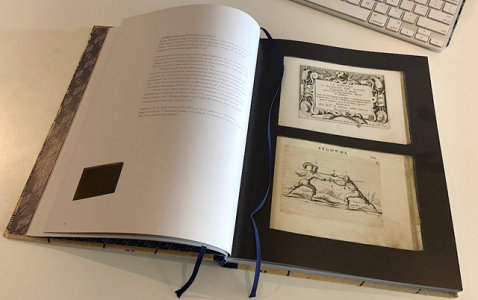
Opening with a frontispiece featuring an inset of the "target"
cutting lines plate from Achille Marozzo's 1536 work on one
side, followed by a choice one from Angelo's 18th century small-sword
treatise, The Mokken Collection - Books and manuscripts on
fencing before 1800, is a beautiful publication. Strongly
bound on thick glossy paper and complete with bookmark ribbons,
the book is well made and solid. It presents its subject material
without pretense or fanfare in a manner that sincerely compliments
and even accents the prized volumes comprising the collection.
After a brief preface by the Dutch owner, Weibe Mokken (in
both English and French), then remarks regarding the catalog
entries from author Vogelaar, we are presented with a timeline
of works up to the year 1800 followed by a short bibliography
and index of sources. Spanning almost 200 pages, the Mokken
collection entries are presented in alphabetical then chronological
order. It includes the lesser known and perhaps under-appreciated
1572 work of Bolognese master Giovanni dall' Agocchie, of the
Dardi school. This is followed by entries on the familiar major
titles by Agrippa, two different works by Alfieri, and then
the lesser known rapier work by Jean Daniel L'Agne from 1664.
Featured next - in perhaps a bit of Baroque prejudice due to
its strong connection to modern sport fencing - is an extended
section from the famous editions of 18th century small-sword
works by Dominico Angelo.
Other entries include: a 1671 Dutch edition of the German rapier
treatise by the master Bruchius; an anonymous late rapier work,
Der Geöffnete Fecht Boden, from 1706 by a German
fencing master identified only as "C"; and Capoferro's
well-known treatise, continuing with several others on lesser-known
but intriguing Baroque small-sword books. Next are listings
on Fabris, de Gaya of 1678, one of William Hope's titles, and
several other somewhat obscure yet wonderfully illustrated and
revealing small-sword or sabre texts. An entry on the rare manual
of Manciolini (one of my personal favorites) is included, continuing
on to Marcelli from 1686, and then splendidly presented entries
on both Achille Marozzo and Joachim Meyer, surely two of the
most important and valuable works to today's Renaissance martial
arts practitioner. Between these, John MacArthur's 1784 book
is recorded, followed by a 1635 edition of Narvaez, along with
those of Pallavicini, De Rada, Thibault, Senese of 1660, and
between them a few additional small-sword and sabre works. Particularly
interesting is a little known Neapolitan work by Pedro Texedo
from 1678 that references Sicilian fencing. One of the final
manuals is that of Marco Vandoni, 1781, which curiously is among
the most rapier-like of small-sword texts that I have ever come
across. Entries on Viggiani (Vizani) from 1570 and Weischner
from 1765 end out the collection.
One of the more fascinating entries is for a form of 3-D cutout
known as a "peepshow." This c.1740-50 color example
depicts an intriguing fechtschule practice scene showing
what appear to be pole-arms and longswords in use, as well as
dussacks and sabre versus foil, along with the familiar accompanying
fight-school drummer and flautist. Unfortunately, the entire
peepshow scene was not shown very clearly.
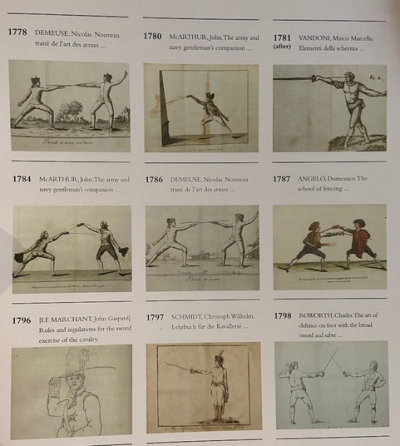
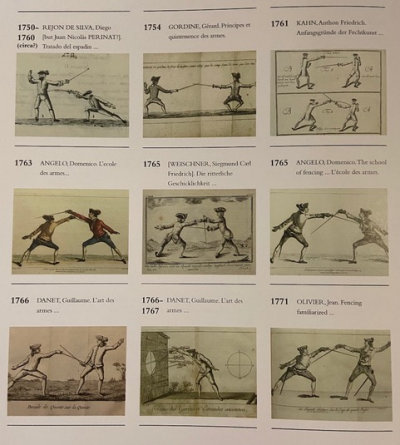
Each entry of the 54 books in the Mokken Collection is brief
but concise in offering factual bibliographical and historical
background along with select images. The insightful factual
tidbits contained in each entry, along with the gorgeously reproduced
plates, are alone worth the price of the book. The importance
of the now more famous and influential Renaissance-era titles
within the collection certainly speak for themselves. The considerable
Baroque content by contrast is displayed in a way that the reader
may note its connection to Renaissance works, but also distinguish
the transition from earlier broader concerns and necessities
of total self-defense to the later aristocratic methods of dueling
and the military needs of light cavalry.
We could easily ask for more in-depth descriptions of their
content and their significance within the martial context of
their historical era, but that is not the purpose of this work.
Instead, it serves as both a formal documentation of the collection,
and also as a love letter of sorts to the works by a fencer
and bibliophile. Being both myself, and having long stressed
the near impossibility of being one without being the other,
I am most appreciative of having even this first portion of
the Mokken Collection in my own library. It's very easy to wish
it contained more images from each work, so the only criticism
would perhaps be that there's a considerable amount of empty
space that could have been filled easily enough with more plates
without taking away from the book's overall aesthetics. Still,
there are certainly several interesting factoids to be found
throughout that any fencing bibliophile will enjoy.
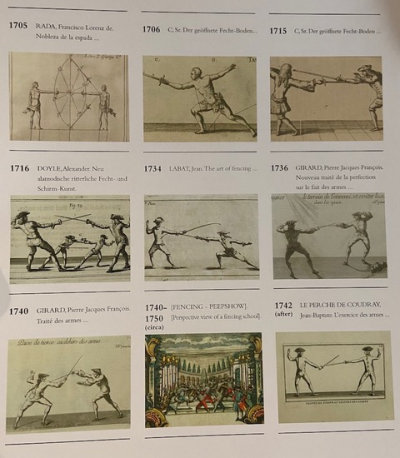
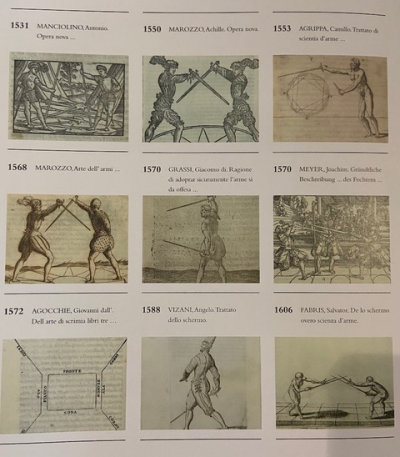
On the critical side, one complaint I might level is the wish
that with each entry the date of the work were listed prominently
following the author. The same might also be said for the inclusion
of a short title directly after. This would allow it to be more
easily referenced when looking at the larger subject chronologically.
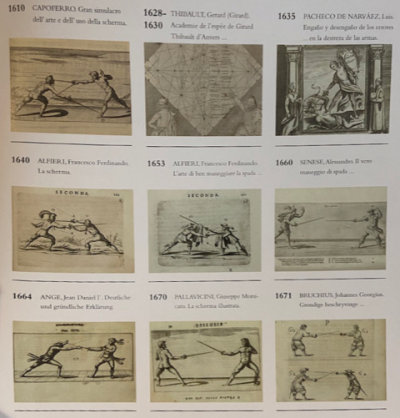
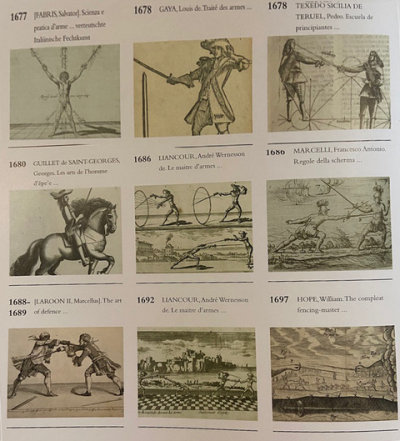
However, this is amended in the back of the book with a convenient
timeline of thumbnails. If anything else, some of the comments
on content of the entries still bear the influence of modern
fencing's prejudices despite what all is now known about 14th
& 15th century methods. The continued deference to somewhat
outdated notes by pioneering 19th-century authorities (Thimm,
Castle, Gelli, etc.) also reveals the need for more modern authorities
schooled not only in post-17th century fencing, but well-versed
in the earlier methods of European martial arts treatises.
For example, a statement is made that Demeuse from 1778 originated
the concept of sentiment du fer even though it's a major
element expressed more than 150 years earlier in Thibault's
work (which is actually in the Mokken Collection!) - and arguably,
is also the very basis of Liechtenauer's own 14th century teachings.
More odd is the note that di Grassi was "written at a time
of transition from heavier swords to longer lighter ones,"
when in fact that transition arguably took place more than 25
years earlier, as evidenced by the blade style distinctly featured
in Agrippa's own treatise. The side-sword illustrated in di
Grassi is not all that different either in dimension, geometry,
or hilt from ones featured in notable works published in the
1550s and even the 1530s, as is self-evident from illustrations
included in this very book. Not only this, but di Grassi distinctly
included the common military arms and armor of his time, even
surrounding himself with an array of them in his author illustration.
Another profound element of fencing history documented in the
literature is the central idea of offence as defence through
the concept of counter-striking in a single tempo. But the critical
alteration toward a simpler double-time parry-riposte method
used with the later small-sword and saber is not noted.
It's one thing to read a short, dry listing in a bibliography
of fencing and dueling, and another entirely to see images featured
out of an actual known existing copy of such a work along with
comments from the owner of that very title. In many ways it
makes it all more real than any high-res digital reproduction
(invaluable to our study as those are). Real books tell a story:
of their publication, their provenance, their reception and
influence, and their acquisition and ownership through the years
that no mere digital files can ever match. (Think of your own
favorite book - how you first encountered it, what it meant
at the time you first read it, and what memories and experiences
you attach to it now.)
One could only wish that, given some of its most enviable volumes,
the Mokken collection may itself soon become fully digitized
even as this work might inspire other similar collections to
publish their own catalogs of this quality. What a delight it
must surely be to spend even a few hours in person in the presence
of such a library encompassing this rich and diverse a cross-section
of Renaissance and Baroque swordsmanship. It's hard to go wrong
when combining two beloved ancient subjects - books and fencing
- that have themselves nearly always been paired to one another
- arma et literae as the saying goes.
I deeply love fencing history. The only thing that I enjoy
more than writing about historical fencing and fencing books
is practicing and teaching their content. We are fortunate now
to have many published facsimiles of the fight-books, but for
many works we must still collect our own digital libraries,
gathering up what we wherever we can and sometimes even printing
and binding them ourselves. Every student obsessed with doing
so must relate to the challenge and rewards of assembling original
editions together such as with the Mokken collection.
While younger students of the subject today may dismiss books
like this as less relevant given the availability of online
content, that these training manuals and study guides were originally
in book form gains greater import when we again hold in our
own hands even portions of them once in printed media. Just
as we may on occasion hold historical specimens of fine swords
in our hands, there is never going to be a more satisfying alternative
to the experience of bound paper. Let us hope to see more of
the Mokken collection in the future.
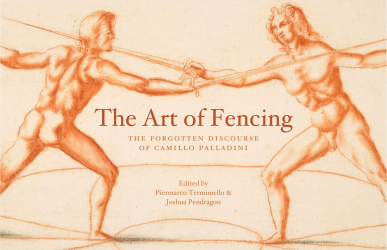 The
Art of Fencing: The Forgotten Discourse of Camillo Palladini The
Art of Fencing: The Forgotten Discourse of Camillo Palladini
Piermarco Terminiello and Joshua Pendragon
The Royal Armouries, 2019
ISBN: 978-0948092961
Illustrated, 256 pages
Reviewed by David Kite
Camillo Palladini counts among the greats of renaissance Italian
fencing masters. But while his name has been known to historians
of fencing, his fencing treatise has been little more than a
rumor and a myth. Only pieces had ever been seen by the public
in published books, and very few individuals have had the privilege
of examining it personally. Its 46 red chalk illustrations are
simply too fragile. Now, after a partnership between the Wallace
Collection, where the manuscript is currently kept, the British
Library, the Royal Armouries, and funded with a grant by the
Aurelius Trust, Palladini's mysterious manuscript is for the
first time widely available. Edited and translated by Piermarco
Terminiello and Joshua Pendragon, this large hardcover edition
reproduces in high detail both the illustrations and the text,
and includes a transcription alongside the translation. Although
virtually nothing is known of Palladini, the editors have assembled
a brief biography of the master, and have convincingly dated
the book to the late 16th or early 17th century. Through their
introduction and endnotes, they have also ably placed Palladini
within the wider context of Bolognese fencing, comparing and
contrasting him with other Italian masters throughout the Renaissance
and Early Modern Period.
Palladini's book includes instruction on the sword alone, sword
and dagger, sword and cape, dagger alone, two swords, and various
weapons against the pike, including the spadone, the halberd,
and the pike against itself. Palladini holds the art of fencing
with two swords simultaneously of high importance, to be learned
after studying the sword alone and before learning sword and
dagger. Learning how to fence with two swords not only makes
the body better balanced, Palladini argues, but it is also valuable
in the event that your sword arm is wounded, you are still able
to defend yourself skillfully.
Apart from his exposition on the theories of fencing which
is lucid and straightforward, one of the more interesting things
about Palladini's book is his ideas about the nature of combat.
Like other fencing masters, Palladini is critical, even derisive,
of school fencing. He complains that the skills learned on a
tiled floor in a controlled setting do not transfer well to
the chaos of a natural environment. He is also critical of other
masters, particularly Agrippa and his mathematical descriptions,
and does not approve of what is perhaps the most famous rapier
technique, the lunge. Palladini also speaks somewhat on the
advantages of weapons, particularly holding the halberd in high
esteem for its versatility, as well as pronouncing its clear
advantage in defending narrow passageways. Like other Italian
sword masters, he speaks on the use and value of cuts and advocates
a style of fencing that utilizes both cuts and thrusts. However,
also like other Italian masters, cuts are rarely described in
his techniques. Peculiarly, Palladini laments non-Italian styles
of fence because they have by-and-large forsaken cuts in their
fencing. This opinion contrasts curiously with the Englishman
George Silver, who also advocated for cut and thrust fencing
and damned Italian fencing for abandoning cuts altogether. Despite
Silver's Italian prejudice, in Palladini he may have had a kindred
spirit.
Palladini's approach to fencing is one of practicality rather
than show. At the end of his book Palladini provides useful
tactical advice for anyone who wears a sword, including considerations
in choosing a glove, carrying a sword at night, or how to draw
the sword quickly if suddenly set upon while sitting at a table.
Finally, while the use of the sword implies the willingness
to kill an opponent, and Palladini's teachings are clearly lethal,
he advocates a non-lethal approach to combat as much as possible,
admonishing men to avoid duels and unnecessary violence.
The Art of Fencing is a fabulous work and a welcome addition
to the modern corpus of European martial arts literature. Both
the book itself and its content are of very high quality and
despite its high price tag, belongs on the shelf of any serious
student of European martial arts and the rapier in particular
 Historical
European Martial Arts in Its Context: Single-Combat, Duels,
Tournaments, Self-Defense, War, Masters and Their Treatises Historical
European Martial Arts in Its Context: Single-Combat, Duels,
Tournaments, Self-Defense, War, Masters and Their Treatises
Richard Marsden
Tyrant Industries, 2016
ISBN: 978-0984771660
Illustrated, 215 pages
Reviewed by David Kite
In Historical European Martial Arts in Its Context, Richard
Marsden has set out to write a very basic introduction to the
world of martial arts in Europe from the 13th through the 18th
centuries. He covers a lot of ground in a couple hundred pages,
devoting separate chapters to single combat, the judicial duel,
the private duel, self defense, tournaments, war, weapons, as
well as the masters and the printed books and manuscripts they
wrote. Such a general introduction is a welcome addition to
the growing body of literature, as most books tend to be much
more specialized.
Marsden clearly has a very broad knowledge of his topic, and
he mingles historical anecdote with brief treatments of some
of the scenarios within which someone may need knowledge of
the martial arts. However, while he gives a lot of information
on the "what", he never gets into the "why"
of things, and events and details are presented at such breakneck
speed, most of the chapters lack any real sense of cohesion
or depth. Most of the chapters come across as strings of random
facts. Fortunately, this by no means applies to the entire book.
In the later chapters dealing with the weapons and then the
masters and their treatises, Marsden does slow down and provide
some discussion and more interesting thought. In fact, had Marsden
focused his book more and provided the same level of detail
throughout, it would have very much strengthened the book overall.
In my opinion, one of the central weaknesses to this book is
that while Marsden makes use of a variety of source material,
he provides almost no analysis and fails to incorporate them
into a cohesive thesis other than perhaps "here is some
information on duelling" or "here is some information
on medieval warfare." Moreover, he seems to take all of
his sources at face value. This is most apparent in the fact
that he relies a lot on the interpretations of 19th century
fencing historians, most of which are known to be inaccurate
and obsolete. Only a small number of historical examples get
more than one or two brief paragraphs of treatment before Marsden
rushes off to the next one. Once again though, this changes
with his chapter on the weapons often found in the fightbooks,
and his chapter on the masters and their treatises. These two
chapters are where Marsden is clearly not only the most knowledgeable,
but also the most comfortable writing about, and in this last
third of the book, we finally get some meaningful analysis.
I can certainly appreciate Marsden's excitement for this subject,
and can relate to wanting to include as much information as
possible to show how cool historical European martial arts are.
However, overall the book would really have been strengthened
if it included more focused analysis into fewer tidbits and
anecdotes.
Anyone with no prior knowledge of either the history or context
of the martial arts of Europe will find this book a good basic
introduction to the topic, and may find it a useful springboard
to more in-depth reading.
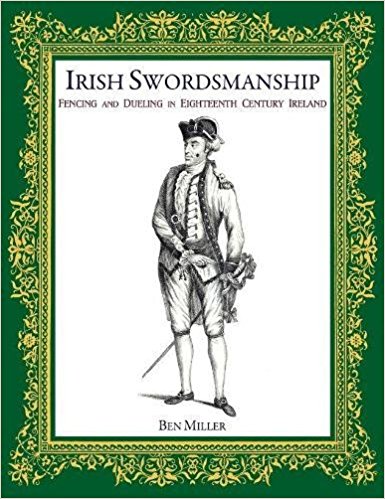 Irish
Swordsmanship: Fencing and Dueling in Eighteenth Century Ireland Irish
Swordsmanship: Fencing and Dueling in Eighteenth Century Ireland
Ben Miller
Hudson Society Press (October, 2017)
ISBN: 978-0999056714
Illustrated, 502 pages
Reviewed by David Kite
Ben Miller's Irish Swordsmanship: Fencing and Dueling in Eighteenth
Century Ireland is a welcome addition to the corpus of historical
European martial arts literature. While there are numerous book
on dueling and the martial arts, they tend to be either very
broad in scope or focus on other regions of Europe. Until now,
few have focused on Ireland, which in the eighteenth century
was home to some of the most renowned swordsmen in Europe. Miller's
book fills this gap in our knowledge. Though technically outside
ARMA's period of interest, it still provides fascinating and
wonderful insight into the culture of violence that existed
in the daily life of early modern Europe, whether as entertainment
on the stage, duelists in single combats, gangs that terrorized
the streets, or the fencing societies and individuals who took
it upon themselves to bring some sense of order to the abuses
and chaos of it all.
Miller's treatment is very well executed, and his knowledge
and affection for his subject is clear. What he has accomplished
is a book that is not only informative but engaging. As a writer,
he is able to provide a text rich with information without bogging
the reader down with excessive or tangential detail.
Miller tackles his subject from several angles. He provides
a thorough treatment of the culture of dueling in Ireland, where
quarrels arose out of genuine matters of honor, but also where
men casually picked fights and killed each other either out
of machismo or boredom. He then treats of the gladiatorial stage
performances of Irish masters of defense, the prize fighters
who, like their English counterparts, demonstrated their skill
at swordplay with sharps and risked gruesome mutilation and
sometimes death for fame and a little money. Impressively, Miller
is also able to provide short biographies of many of Ireland's
famed duelists and gladiators. He next describes the street
gangs and dueling clubs that plagued Ireland's cities, which
demonstrated as much as anything else the vital need for citizens
to arm themselves and be skilled in the science of defense.
Duelists, gladiators, and gang members provided not only the
students, but also the teachers of Ireland's fencing schools,
Miller's next chapter, who not only furnished the Irish with
technical skill, but also promoted themselves with their own
fencing exhibitions and contests. Miller caps off his historical
treatment with a chapter on the famed Knights of Tara, a society
of fencers who charged themselves with promoting the usefulness
of skill in the science of defense, and acted as a regulatory
body in an effort to reduce what they perceived as abuses and
excesses of dueling.
If that wasn't enough by itself, Miller proceeds to wrest from
obscurity an anonymous Irish fencing book first printed in 1781
and subsequently ignored for the next two centuries: A Few Mathematical
and Critical Remarks on the Sword. Miller provides a faithful
transcription of this lengthy work, and makes a compelling argument
regarding the identity of the author. Devoid of illustration,
it is nonetheless a lively and spirited instructional work.
Copiously cited, the book boasts an ample bibliography, and
Miller clearly took advantage of a large number of primary and
secondary source materials and synthesized them into an eminently
readable volume. Even if Irish Swordsmanship inspires future
works on Irish fencing, Miller's work will certainly be authoritative
for quite some time.
 Late
Medieval and Early Modern Fight Books: Transmission and Tradition
of Martial Arts in Europe (14th-17th Centuries) Late
Medieval and Early Modern Fight Books: Transmission and Tradition
of Martial Arts in Europe (14th-17th Centuries)
Edited by Daniel Jaquet, Karin Verelst, and Timothy Dawson
Brill Academic Publishing (July, 2016)
ISBN: 978-9-004312-41-8
Illustrated, 619 pages
Reviewed by David Kite
Seventeen years ago, Sydney Anglo remarked that the martial
arts of Renaissance Europe and their associated literature had
received scant attention by academics. Despite numerous digital
and print publications by amateur enthusiasts of varying abilities,
his statement remains largely true. Fortunately, this reality
is beginning to change, and the recent publication of Late
Medieval and Early Modern Fight Books: Transmission and Tradition
of Martial Arts in Europe (14th-17th Centuries), edited
by Daniel Jaquet, Karin Verelst, and Timothy Dawson, is a large
step in the right direction. This volume covers a range of topics
by several academic and non-academic researchers. Separated
into three dubiously-useful categories, the seventeen contributions
range from general introductory surveys to microscopic examinations
only a specialist could love.
John Clements' chapter on "Problems of Interpretation
and Application in Fight Book Studies" and Daniel Jaquet's
chapter "Experimenting Historical European Martial Arts,
a Scientific Method?" are both solid contributions whose
arguments are familiar, if not axiomatic, to veteran practitioners.
However, it is because of their straight-forwardness and practicality
that they are valuable and important introductions for academics
who might operate too much on the intellectual and theoretical
level.
A few chapters I found to be especially interesting. Paul Wagner's
"Common Themes in the Fighting Tradition of the British
Isles" examines the surviving British sources from the
fifteenth to the eighteenth centuries, and identifies common
threads between them which illustrate a stronger homogeneity
than I was aware of. Bert Gevaert and Reinier van Noort's "Evolution
of Martial Tradition in the Low Countries: Fencing Guilds and
Treatises" offers a fairly in depth look at those guilds
and attempts to identify whether the Low Countries developed
their own unique martial traditions. Their examinations of the
local guilds are not only interesting in their own right, but
allow useful comparisons with other European fencing guilds.
B. Ann Tlusty's "Martial Identity and the Culture of the
Sword in Early Modern Germany" provides an overview of
exactly that, focusing on the civilian aspects of who taught
whom and why.
Most of the pieces in this volume were well written and worthy
additions, such as the pieces on the French, Italian, and Spanish
traditions, as well as the close studies of certain specific
sources, traditions, or time periods, but weren't necessarily
things that interest me personally. Matthias Bauer's contribution,
for example, is a very close linguistic examination of some
German sources that will likely be of no interest to any but
the most dedicated general reader and martial arts practitioner.
It is, however, an otherwise fine contribution and illustrates
some of the problems which occur when we use one source to help
interpret another when their connections are spurious at best.
However, the volume is far from perfect, with some chapters
being more of a headache than an educational experience. Overall,
this book could have benefited from another round of, or at
least more, editorial scrutiny. There are many word choices,
phrases, and sentence structures that you just don't encounter
in English, and there is a frustrating amount of head scratching
to try and figure out what some authors are even trying to say.
This may be due to language barriers (the two chapters in mind
were written by non-native English speakers) as much as the
authors' writing styles. This is not a fault of most of the
authors in this volume, as most of the pieces have a very fluid
narrative style and are easy to read. I also don't think this
is a matter of my own abilities, because I've read some pretty
dense academic works and I've never had to work so hard simply
to understand them. One particular example is the piece by Jens
Peter Kleinau. On page 90, he writes: "A collection of
images in a pragmatic domain is a collection of displayed knowledge.
With a few exceptions the images in such a collection seems
to have no other intention than the communication of the pragmatic
content." And on page 95: "While a collection stands
as a collective object for its own purpose, those pragmatic
books had been used." In Karin Verelst's chapter, we read
on pages 120-121: "A diplomatic edition is, however, not
a visually as much as possible resembling copy of the original,
which is what one often sees when philologically uninformed
scholars or researchers present an in their opinion 'faithful'
Word for Windows-facsimile typoscript of a source." As
already stated, most of the contributions to this volume have
a fairly relaxed, if formal, narrative style which gives precedence
to the communication of ideas. This should be one of the ideals
of academic discourse. Kleinau and Verelst's pieces, however,
give the impression that their primary goal was impressing the
academic establishment with their lexical erudition at the expense
of communicating clearly. They seem to have gone out of their
way not to be easily understood. The result is a particularly
jarring and head-scratching experience. Their theses are fairly
straightforward and the underlying ideas fairly simple, but
in the end, understanding their convoluted discussions was hardly
worth the effort.
Despite some weaknesses and glaring faults, overall, Late
Medieval and Early Modern Fight Books should prove to be
an enduring and highly valuable contribution to the scholarship
of European martial arts. With a current price tag of over two
hundred dollars, this book is unlikely to end up on the general
reader's bookshelf, but it is well worth the effort of acquiring
though the library.
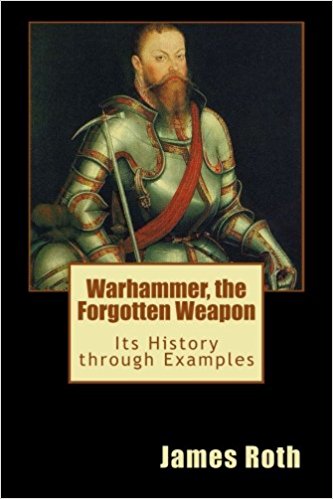 Warhammer,
the Forgotten Weapon: Its History through Examples Warhammer,
the Forgotten Weapon: Its History through Examples
James Roth (pseudonym)
CreateSpace Independent Publishing Platform (June 21, 2012)
ISBN: 978-1477680858
Illustrated, 120 pages
Reviewed by Eric A. Harrelson
In the book Warhammer, the Forgotten Weapon, the author
James Roth, a pseudonym, attempts to delve into the history
of the European warhammer, a weapon that was created to deal
primarily with plate armor, or harness. His thesis is... well,
he does not have one, or one that is stated. A suggested thesis
would be that this is a book that needs to be written due to
the fact that there is no general work on the weapon; therefore,
he is starting it off.
The author's main point is that there are basically two types
of warhammers found in Europe that came about due to the Medieval
arms race taking place: Western and Eastern. Each one fulfilled
the function of an offensive weapon designed to breach the defensive
armor of the region. In the West, it was plate armor and in
the East, it could be plate, ring mail, a combination of both,
or neither. Therefore, the type of hammer reflected the type
of armor it was designed to defeat.
All in all, if I were to give this book a rating, it would
be 2.5 stars out of 5. The pros of this book counter the cons
equally. The pros of this book are that "James Roth"
describes himself as a technical writer specializing in modern
weapons systems. Therefore, his logic in deducing the use of
the Warhammer in various parts of Europe is quite good and his
job as a writer stands him in good stead. The cons of this book
are his utter lack of knowledge of Armizare or the Martial Arts
of Renaissance Europe. "James Roth" also mentions
that he fenced competitively at the U. S. regional levels and
he is a trained bayonet fencer. This, unfortunately, does not
truly qualify him to interpret the efficacy of the weapon he
is writing about and the treatises he is using to come to his
conclusions.
This book is a good starting point for this particular weapon.
While it is not the best it does offer some good insight. If
someone wishes to continue the scholarship of this weapon, I
would suggest they start here.
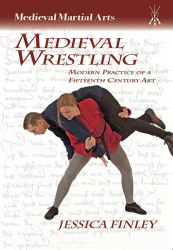 Medieval
Wrestling: Modern Practice of a Fifteenth Century Art Medieval
Wrestling: Modern Practice of a Fifteenth Century Art
Jessica Finley
Freelance Academy Press (2014)
ISBN: 978-1-937439-11-8
Illustrated, 168 pages
Reviewed by John Farthing
I was rapt with anticipation about this book for several reasons.
In an already niche market of historical martial literature,
this book sets itself further apart by being one of extremely
few to focus on the unarmed combatives of the Mediæval
world. I was equally enthusiastic to see a book of this type
coming from a female author in a subject which has been largely
the monopolized by men. This excitement waned somewhat upon
reading of the author's research methods.
While I applaud the author's efforts and it is obvious that
she has spent some time studying the original sources which
she uses as the base of her assertions, the book declares, with
what seems like pride, the very flaw which calls the entire
work into suspicion! While the book purports to be a guidebook
towards understanding the unarmed combatives of Mediæval
Europe (and specifically Germany in this case) it boasts that
the interpretations of the techniques are grounded in the author's
understanding of Judo. While there are certainly and inarguably
many similarities between Mediæval German wrestling and
Judo, integrity of scholarship is compromised when one uses
such 'frog DNA' to form the building blocks of their reconstruction.
The diligent reader who has leanings toward understanding the
unbiased historical reality must retain this knowledge in their
mind throughout studying this material.
This is not to suggest that this book is not without merit.
In fact, for an entry level practitioner, or the swordsman seeking
to explore another avenue within the martial corpus of Mediæval
and/or Renaissance Europe, this book does a good job of providing
a basic framework introduction of the wrestling art of one 'Master
Ott'. The book offers a brief introductory synopsis of the martial
arts of Mediæval Europe and provides some context to the
climate in which they were practiced. The same treatment is
then given to a discussion of Ott himself, providing a brief
understanding of the man and his role in the pantheon of European
martial literature. Most notable is the inclusion of a translation
of the original material from Ott himself, which although readily
available elsewhere is nice to have in a bound book which the
practitioner can (as the author suggests in her introduction)
'tuck into your gym bag'.
In short, this book is open and forthright about its interpretations
being colored by outside influence in the form of Judo and that
it isn't meant to be the definitive work on the subject, but
it is well written and seems to convey the author's passion
for the subject matter. It is there that this book really shines.
On a technical level this book only serves to offer the most
basic entry level understanding of the practical application
and usage of 'Ott's wrestling', but the author's enthusiasm
being present throughout is noticeable and should serve to whet
the appetites of readers to pursue this fascinating topic further
beyond the introductory material this book provides.
 The
Sword of Combat or The Use of Fighting with Weapons The
Sword of Combat or The Use of Fighting with Weapons
François Dancie, translated by Rob Runacres & Thibault
Ghesquiere
Lulu publishing (2014)
ISBN: 978-1-291-91969-1
Not Illustrated, 63 pages
Reviewed by John Farthing
As a researcher and practitioner of Renaissance martial arts,
I frequently lament the mass of translations being accompanied
by the translator's need for self validation by including what
are, more often than not, distracting and dissatisfactory 'interpretations'
of the original content. I have long hoped to see more volumes
being produced which offer simply a straightforward translation
while leaving the interpretive process to the reader/researcher.
On that count, this volume surely delivers!
Being little more than just a straightforward translation of
the original source, I found this volume to be a real delight!
The translators offer a brief introduction which provides appropriate
historical information, a brief description on how the translation
came about, the obligatory acknowledgements and expressions
of gratitude, and then unabashedly straight into the translation
itself! Footnotes are included where appropriate and yet the
book is not overly annotated. Further commendable is that while
the translators dispensed with the usual interjections of their
own ideas and interpretations, they saw fit to include an index
which provides the researcher with an all too often neglected,
but valuable resource.
As to the content of the book itself... without offering the
tedious 'interpretations' I chastise above (this is a book review
and not a fencing lesson), I will simply state that for anyone
with an interest in seventeenth century fencing, this tome would
make a worthy addition to any fencing library. The original
author's approach to fencing is as straightforward and direct
as was the translator's approach towards it. Some readers might
lament the lack of any illustration, but both the author (who
declares his disdain for illustration in the text!) and the
translators, succeed in having produced a volume in which the
clear and descriptive language should convey the material satisfactorily
to anyone familiar with the fencing literature of the period.
I thoroughly enjoyed this volume and the freedom to study the
author's original words (albeit now in my native language) without
the distractions of the translators' interjections. I hope to
see more volumes being approached in such a fashion in the future,
and I highly commend and applaud the translators for having
done so in this one.
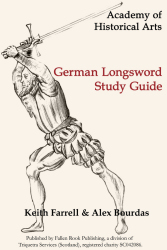 German
Longsword Study Guide German
Longsword Study Guide
Keith Farrell and Alex Bourdas
Fallen Rook Publishing (2013)
ISBN: 978-0-9926735-0-5
Illustrated, 132 pages
Reviewed by John Farthing
In an age when it has become all too commonplace for pimply
faced youth with barely any life (let alone martial) experience
to set themselves up as 'instructors' of an art which itself
has yet to be fully rediscovered; where dozens of new schools
and clubs are popping up all over the world in 'McDojo' like
fashion at ever increasing and alarming rates; and where 'sportification'
has sadly overshadowed the focus on legitimate defensive skills
and the use of historically accurate training tools and equipment...
I must admit, I had some reservations about this little book.
The virtual explosion of interest in the subject of Historical
Fencing has not been solely limited to the classroom, club or
tournament grounds either, it has also witnessed a literary
'boom' with more books on the subject being produced in the
last 15 years than in the preceding 150! With the above in mind,
my primary concern (or perhaps more appropriately... question)
was, 'What is the need for such a book as this?' Are we not
told in the extant martial literature itself that (according
to Anonymous Gloss HS 3227a or 'Döbringer' manuscript)
"There is nothing new that can be devised which is not
already contained in Liechtenauer's art"? What then, I
could not help but wonder, is the need for yet another modern
attempt to interpret already complete sources of information?
Given the trends (and seeming popularity) of modern authors
offering their opinions and/or interpretations of original sources
overshadowing those aforesaid sources themselves, I couldn't
help but wonder if the world really needed 'just another guidebook'.
The answers to my aforementioned questions and concerns, I
am pleased to admit, were a welcome surprise! Before offering
my thoughts on the book proper and its contents, I hope the
reader will indulge a few words about the authors themselves.
The book is a collaborative effort between Alex Bourdas and
Keith Farrell; of the former I know virtually nothing. Mr. Farrell
on the other hand, I have met. I know him and I consider him
a friend (to wit, I have made every effort to be objective and
unbiased in this review). Mr. Farrell is young, a point which
at the outset of this review I admit gives me pause, but I can
assure you that Mr. Farrell's knowledge of the subject and the
original source material is impressive for a person of any age.
In my many 'face to face' conversations with him, he has always
conveyed a passion for, and familiarity with, the subject for
which I have held him in some regard.
The book itself is a slight volume, coming in at a mere 132
pages cover to cover; however, the authors seem to have made
great use of such small space and manage to at least touch upon
considerable content within this tiny tome. A book of this size
is certainly not going to be remembered as the definitive work
on the subject, but in reading it seems apparent that this was
never the authors' intent. The title itself further indicates
this as the book is clearly and unabashedly a 'Study Guide'.
If we take that to be the authors' stated objective, then it
can be said that on that count, they surely deliver. One of
the most noteworthy, and indeed impressive, things about this
book is that it not only serves as a self contained guide in
its own right, but it also serves as a starting guide for further
study. This is made possible by the fact that the book is well
footnoted and the sources which the authors drew upon in their
writing can be further followed, read and studied by the readers
of this book. I will be the first to admit that there are elements
contained within this volume with which I agree, and others
with which I do not. The fact that the sources of the authors'
information and research are so well listed and made openly
available makes it easy to see 'where they might have been coming
from' on a particular issue, and/or to follow up on points that
interest the reader further or to gain greater insights into
content the reader might not agree with or understand. I truly
commend the authors and the book for being so well documented,
footnoted and forthcoming with regard to same.
While I believe this book has the potential to confuse some
readers (although again, it does make continuation of study
easy for the enthusiastic reader to find out more), I feel as
though the authors have made a sincere and valiant effort in
attempting to explain the differences between those things which
might confuse a neophyte of the subject. In fact, it is the
simplistic yet obviously knowledgeable way in which the authors
present the material where I think this book really shines.
For persons new to the subject, or those not yet well versed
in the taxonomical German nomenclature, this (albeit small)
volume presents a well rounded catalog of basic concepts, terms
and ideas which are refreshing to see presented in such a handy,
portable guidebook. Experienced students and practitioners of
the craft may find themselves lamenting that such a compact
yet comprehensive guidebook was not available years ago.
In short, this book is not without its flaws, but is an impressive
and noble inaugural effort from two authors whose dedicated
research and study of the themes presented are in evidence throughout.
For the experienced scholar of Historical Fencing studies, you
will likely find nothing new or groundbreaking here, and yet
this book would still make a welcome addition to your library
as a quick reference guide, etc. (I have found myself drawing
upon it for reference several times myself!). For those who
are new to the subject of Mediæval and/or Renaissance
Martial Arts (and particularly the German corpus), provided
the reader is judicious and takes care to notice the authors'
discussion of the differences between sport, real martial art,
etc. this book certainly has the potential to be a great starting
point and one that will likely eventually become a treasured
volume to which you might find yourself referring back to for
years to come!
The Longsword Teachings of Master
Liechtenauer: The Early Sixteenth Century Swordsmanship Comments
in the "Goliath" Manuscript
Grzegorz Zabinski
Wydawnictwo Adam Marszarek Press (2010)
ISBN-10: 8376116622
ISBN-13: 978-8376116624
Illustrated, 595 pages
Reviewed by David Kite
A published translation of MS Germ. Quart. 2020 (known as the
"Goliath" manuscript) has been long overdue, and this
book, by Gregorz Zabinski, is a welcome additon to the growing
body of available German martial arts books. In addition to
a transcription and translation of this manuscript, Zabinski
provides his own analysis of the text, as well as an analysis
of European martial arts overall, a treatment of the "tradition"
of Liechtenauer, and an analysis of the represented swords themselves.
As a special bonus, this book also includes a concordance of
master Johannes Liechtenauer's verses, a project Zabinski has
been rumored to have been working on for years.
The front matter of the book, treating the history of the martial
arts in the Middle Ages generally and Liechtenauer specifically,
demonstrate that Zabinski is well read and knowledgeable in
the subject. Although I found his writing style rather dry and
perhaps merely an attempt at an academic style, the information
is interesting and well synthesized.
The jewels of this book are the translation of the Goliath
manuscript and the treatment of Liechtenauer's verses. While
either of these parts by themselves would involve a great deal
of time and effort, together the volume represents a tremendous
undertaking, and I applaud Zabinski for his effort and ability.
While the contents make this book more than worth the price,
unfortunately, the book's major failure lies in its execution.
Two minor issues are the translation itself and the photographs.
I also own copies of Zabinski's translations of Codex Wallerstein
and MS 3227a (the "Döbringer" manuscript), and
compared to those earlier works, the English simply isn't as
good, which struck me as odd. As a quick example, he translates
"zufechten" as "in an armed manner." While
I think it is a valid interpretation, it sounds clumsy and unnecessarily
wordy to my ear, and this idiosyncratic style is present throughout.
The translation seems accurate, just not his best work, and
the English lacks the clarity and oomph of the previous two
works. Second, while he does include B&W images of the original
illustrations, he also includes pictures of two fencers "performing"
some of the techniques, which are grainy, static poses, and
are completely useless.
When reading other translations, such as of Ringeck or Meyer,
their texts are left whole, and any commentaries or comparisons
by the editors are clearly delineated. Not so with this edition.
Zabinski regularly interposes his own glosses of the glosses,
as well as relevant yet lengthy passages from MS 3227a, and
occasional passages from Peter von Danzig. The inclusion of
these passages is not the issue. Rather, the issue is that there
is very little to differentiate these passages from the Goliath
text proper. If you're not paying close attention, it's easy
to read Zabinski's comments as part of the original gloss, since
there is no change in the appearance of the text from the verses,
glosses, or his comments. The result is that if the reader only
wants to read the Goliath text without the editor's glosses
or other passages, it is very difficult to do so unless the
reader is willing to mark up his copy considerably.
Further, Zabinski's own glosses often amount to little more
than repetitions of the original gloss, are overly technical,
and add little actual content or elucidation. For a beginner,
the extraneous information and over-technical examination may
be confusing, but for an experienced martial artist already
familiar with the content, it is superfluous and distracting.
In my initial reading of the translation, I quickly stopped
reading Zabinski's own comments, and consequently missed when
he indicated he would include portions of Döbringer or
von Danzig. As a result, I had to spend effort paying close
attention to the manuscript page numbers, normally unimportant
details themselves, so that I knew which manuscript a given
passage belonged to.
Most annoying, however, is his habitually interjecting his
own interpretation of the text in-line with the original text,
with only simple brackets delineating his comments. Such commentary
would be better placed as footnotes. Unfortunately, as with
the editor's other commentaries, they add absolutely nothing
in terms of content, often being repetitions of the text anyway.
As an example, for the überlauffen (p383) "If one
presses you down [i.e., if the adversary presses your sword
down while fighting "am schwert"], run him over and
strike firmly again. Run over from both sides and watch the
edges [make sure the edge is placed correctly while fighting
"am schwert"]."
His footnotes are good, actually doing what footnotes are supposed
to do: supply information and comments without distracting from
the main body. In them, Zabinski often provides the untranslated
texts of von Danzig and Ringeck for comparison, and notes any
differences in the versions. These are interesting, but only
if you can read and understand the German.
Years ago, it was rumored that Zabinski was working on a concordance
of the Liechtenauer verses and their glosses, both to compare
the glosses, and show which verses are missing from, or extras
in, existing versions. The appendices appear to be the culmination
of this work, and if so, then I am disappointed, although my
expectations may have been unrealistically high. Zabinski does
provide a concordance of Liechtenauer's verses of Döbringer
and Ringeck, then one of von Danzig and Ringeck, von Danzig
and Lew, and finally von Danzig and Goliath, all in separate
sections. Rather than providing the entire verses, however,
these concordances appear to be nothing more than Zabinski's
own notes, and apparently accompany his treatment of manuscripts
in Chapter 3. He also provides a table of variations between
the Liechtenauer verses in Döbringer, Ringeck, and von
Danzig, actually providing transcriptions of those verses, but
provides no explanation as to why this table is different than
the other concordances.
In short, I bought the book because I wanted to read Goliath
the way I can buy Lindholm's or Tobler's translation of Ringeck
and only read Ringeck. However, the format of the editing and
the absolute refusal of the editor to simply let the manuscript
speak for itself amount to a fractured and frustrating read
of what should be a very approachable work.
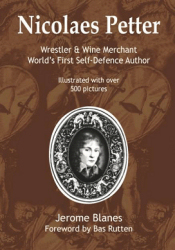 Nicolaes
Petter: Wrestler & Wine Merchant Nicolaes
Petter: Wrestler & Wine Merchant
Jerome Blanes
Lulu press, 2013
Illustrated, 635 pages
Reviewed by John Farthing
Having had the privilege of leafing through an early editorial
'mock up' of this tome nearly a year before its print release,
I had been eagerly awaiting this book’s publication. By
the time the final version went to print, the volume had increased
in size and scope exponentially. In reading, it is readily apparent
that the author has invested considerable time and research
into compiling the material; however, one of its few shortcomings
is in the lack of any bibliographical information or indexes.
Such omissions notwithstanding, the sheer size and scope of
this impressive work is a refreshing and long overdue treatment
of its fascinating subject matter. This book will, no doubt,
have widespread appeal to historians, martial artists, students
of the sociology and cultural affairs of the early Netherlands,
and many more. As English is not the author’s native language,
the prose presents the information in a direct and simple manner
which results in a surprisingly easy readability. This is a
refreshing change from the often tedious verbosity of works
taking on such high level academic themes.
While the book touts itself as a biography of the seventeenth
century wrestling master Nicolæs Petter (a score upon
which it very much delivers), it is quite a great deal more
than just a 'simple' biographical analysis. The book explores
not only Petter and his life and times, but provides an interesting
foray into the Netherlands of the late seventeenth century.
One gets a clear sense of things, and the author, himself a
native of the Netherlands, relays a sense of national pride
not easily conveyed through the written word. In addition to
the aforementioned content, the book continues to offer more
than just a mere biographical treatment by taking an in depth
look not only at Petter the man, but Petter the martial artist.
The author, also a martial artist, includes a full translation
of Petter's own treatise on wrestling, as well as many training
suggestions! This quickly makes it apparent that this is by
no means a merely ordinary biography about a fascinating
individual, but it is also an exposé on the cultural
zeitgeist of late seventeenth century Netherlands, and a multifaceted
wrestling guide (being a complete guide in Petter's own, albeit
translated, words, and including additional supplemental material
from the author).
The material covered is expansive and seems to be largely accurate,
but the lack of a bibliography makes it problematic for readers
who wish to learn more about a particular topic in this volume.
While the research presented seems to be the most complete treatment
of this subject offered to date, the author’s assertion
that Petter was "the world's first self-defence author"
does not hold up to close academic scrutiny. The book’s
few shortcomings are minimal and do little to diminish the size,
scope and overall impressiveness of this fantastic work. This
book is sure to become a standard against which all future analyses
of Petter and his wrestling are measured. In short, this is
a volume that would certainly enhance the library of anyone
interested in any (or all) of the many themes it explores.
 Furies:
War in Europe 1450 - 1700 Furies:
War in Europe 1450 - 1700
Lauro Martines
Bloomsbury Press; First Edition (January 15, 2013)
336 pages
Reviewed by Tom Reynolds, 04/13
Furies is a new book by Lauro Martines, who is considered one
of the world's leading experts on early modern Europe. He is
the author of nine other books, such as Fire in the City:
Savonarola and the Struggle for Renaissance Florence.
In Furies, Martines starts from the position that early Modern
Europe was not primarily characterized by an artistic or humanist
Renaissance, or a religious Reformation, but rather by the early
appearance and rise of modern nation states. These modern nation
states originated as local-scale states, such as city states
or feudal territories, which grew by incorporating the territories
of their neighbors. The development of modern France is cited
as an example of this process.
As such, Martines claims that the dominant characteristic of
early modern European society was constant warfare. Early rulers
were always looking for ways to expand their territories, which
required the maintenance of larger standing armies than at any
previous time in European history. These armies were typically
made up of mercenaries; that, and the introduction of new gunpowder
weapons, meant that these standing armies were far more expensive
than ever before, and early modern rulers were constantly struggling
to find ways to pay for them.
But modern logistical and transport systems had also not yet
been developed in early modern Europe. This meant that Europe
was constantly being criss-crossed by large, disease-ridden,
starving armies that had not been paid sometimes for years.
Martines calls them "floating cities". Conditions
like these encouraged plunder and looting, and in fact in many
cases it was literally assumed that the armies would pay and
provide for themselves through plundering the country in which
they were operating.
Given this historical context, Martines explicitly sets out
to study the human impact of these wars, not their chronology
or politics of these wars. He does so primarily by relying on
eye witness accounts such as diaries, and case studies such
as the experience of real villages with marauding armies, and
the sack of several real cities. Although he does deal with
military issues, his main concern is with human impacts such
as starvation.
Overall, Martines makes a very clear, very persuasive case
that sooner or later, almost all citizens of early modern Europe
would have been affected by these events; that this constant
warfare would have been difficult if not impossible to escape.
And in the end, the reader is led inevitably to the conclusion
that early modern Europe was far and away more violent than
it is presently.
This book is an excellent companion to the study of the martial
arts of Renaissance Europe, in that it eloquently and effectively
establishes their historical context. After reading this book,
it becomes very difficult not to conclude that those martial
arts must for the most part have been originally intended as
serious military or combat skills. Perhaps they were intended
to prepare the student for a career as a mercenary soldier,
for example, or to prepare the student in case he was forcibly
drafted to serve in the army; a common occurrence, according
to Martines. It is also quite possible that they could have
been intended to equip the private citizen to defend themselves
against these armies. And Martines also makes it clear that
the study of traditional weapons and tactics was quite relevant,
given the fact that it took gunpowder technology several hundred
years to develop to the point that it was truly reliable and
cost effective for infantry.
Lauro Martines writes in an interesting and enjoyable style.
I found the book fascinating, and finished it very quickly,
and found that it helped a lot to put these martial arts in
their historical context. I highly recommend the book.
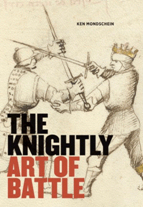 The
Knightly Art of Battle The
Knightly Art of Battle
Ken Mondschein
Getty Publications, 2011
Illustrated, 128 pages
Reviewed by John Farthing
Given the importance of the source material, this book is simultaneously
a delight and a disappointment; however, its many endearing
qualities far supersede those areas where it is lacking. One
of the first things readers will notice (apart from the volume's
small size) is that this work is beautifully presented! Published
by the Getty Museum, the original (albeit limited) source imagery
is presented in truly breathtaking 'museum quality' high resolution.
 The
Book of Swords The
Book of Swords
Hank Reinhardt
Baen Publishing, 2009
Illustrated, 236 pages
Reviewed by John Farthing
Published posthumously after the untimely death of its author
from a collection of notes and materials, this book by the late
Julius 'Hank' Reinhardt debuted with many high expectations
within the spathalogical community. That the author was passionate
about the subject comes through in his writing in no uncertain
terms, even if breaking no new grounds in terms of research,
its perspective is unique.
 In
Saint George's Name In
Saint George's Name
Christian Henry Tobler
Freelance Academy Press
Illustrated, 207 pages
Reviewed by John Farthing
This fourth book from Christian Tobler (the author's first
Freelance Academy Press publication), is unique in that it is
the first publicly available printed volume to offer an English
translation of materials from the 'Danzig' fechtbuch. This latest
submission might also be considered unique because of the eccentric
assertions and theoretical postulations contained within its
brief 207 pages, which add little to enlighten the original
historical material.
|
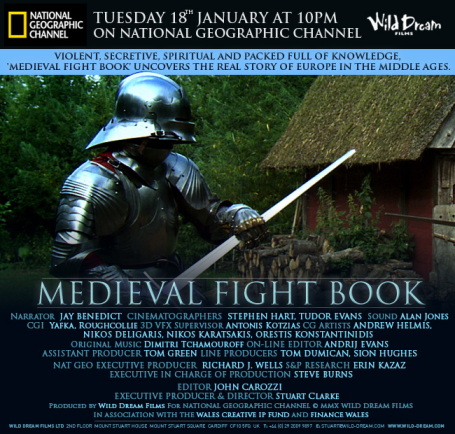 National
Geographic Channel's Medieval Fight Book National
Geographic Channel's Medieval Fight Book
Reviewed By Parker Brown
ARMA-Denton Study Group Leader
April 2011
As a Renaissance martial artist and active member of the ARMA,
the material covered in The National Geographic Channel's presentation
of Medieval Fight Book should have contained few surprises.
I am pleased to say that quite the opposite was the case. Like
many others, I had heard of the development of this television
special through discussions on the ARMA member's mailing list
as well as the ARMA's member podcast. Given its topic and the
involvement of Director John Clements and Provost Aaron Pynenberg,
I knew it would be something of great interest. The show covered
information from one of six surviving works of the 15th century
German Fechtmeister, Hans Talhoffer. This edition, dating
from 1459, contains a myriad of imagery depicting fighting skills
we are familiar with, including wrestling, longsword, dagger,
and sword and buckler. What made Nat Geo's Medieval Fight
Book remarkable was that it addressed aspects of the book
I had either never heard of or had not gotten to examine in
closer detail.
One of the first things that struck me in the program was the
excellent condition the original book was in. The drawings still
have such vivid colors that one could easily assume it was a
recently drawn image. I am truly envious of John for getting
to handle the original work and view such stunning art with
his own eyes. Within that imagery was an understanding of various
engineering projects that I had not heard of, including the
designs of a diving suit and a tank that both predate similar
theoretical designs proposed by Leonardo da Vinci (who would
have been only 7 years old at the time).
Medieval Fight Book was exciting and revealing for a
practicing Renaissance martial artist, but what was more important
was the reaction from those unaccustomed to such knowledge.
After discussing my involvement in ARMA with friends and colleagues,
it's apparent that the idea that our Medieval and Renaissance
forbearers were more sophisticated than we have previously been
told is far more foreign than I had imagined. Sadly, the Victorian
depictions of clumsy knights and damsels in distress are still
the predominantly held view by the broader public. In the case
of Medieval Fight Book, having familiar source material
presented in an easily digestible package that can be embraced
by the wider public is very gratifying. I viewed the show with
several non-martial artist friends and witnessed the dawning
realization on their faces that their previously held notions
were not only inaccurate, but that the historical reality is
far more dynamic and fascinating.
After viewing the show, some friends remarked that they were
astonished and frightened at just how violent that society was
capable of being. One female friend remarked that she felt "cheated"
having not known that women were legally allowed to fight duels
with men and defend their own honor and rights! Another friend
remarked that Talhoffer's book gave a view into the lives of
common people of the time. He felt that most history books simply
glaze over Medieval and Renaissance society through the viewpoint
of the "noble" knight. He felt that "this shows
us the flip-side of the coin".
In general, Medieval Fight Book provided a general audience
a much better understanding of Renaissance culture. I felt that
this was in no small part because of the choice of historical
experts. Each aspect of Talhoffer's book was covered by individuals
well-versed and well educated in relation to the respective
topics. A large amount of thanks should be extended to not only
John and Aaron, but to Mike Loades, Terry Jones, Bettany Hughes,
the producers and everyone involved for making such a well-informed
and dynamic presentation. This was in lovely contrast to other
less well-researched shows that deliberately choose inaccurate
theatricality over historical actuality. Such theatrical depictions
of history have become the mainstay of such "edu-tainment"
shows that have now regrettably dominated The History Channel,
Discovery Channel and TLC.
One section, in particular, showed how unnecessary theatricality
is when one applies an earnest hand to staging historical close
combat. In demonstrating the use of the longsword against an
armoured opponent, John and Aaron relied upon martial skill
rather than choreographed sequences to show how devastating
a blow could be to an armoured opponent from the pommel and
cross guard of a longsword. By allowing the armour and the weapon
to do what they were designed to do, the deadly seriousness
of these techniques was made obvious even to those laypersons
with no first-hand understanding of these weapons. John, Aaron
and the producers of the sequence are to be commended for it.
Overall, I hope that Medieval Fight Book will segue
into a greater understanding by the public at large about the
nature of society and combat during the Medieval and Renaissance
period. It has already illuminated aspects of Talhoffer that
I previously did not know existed. As members of ARMA, we know
that our ancestors were not idiots waiting patiently in the
wings for the Enlightenment and Industrial Revolution. What
matters is that the wider public be made aware of these facts
as well. The importance of historical understanding is underlined
by a comment made by one of my female friends. When viewing
the judicial dueling section, she remarked how, "women's
rights had been there all along, we just simply chose to forget."
Imagine what would happen if we chose to stop forgetting and
instead learned the facts of our origins.
|
|
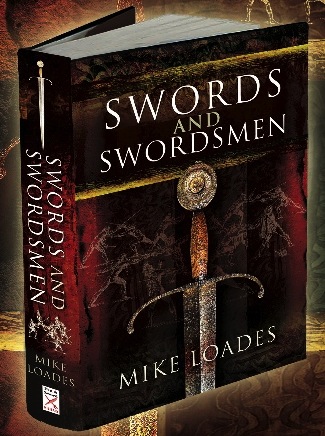 Swords
and Swordsmen Swords
and Swordsmen
Mike Loades
Pen & Sword Books, 2010
Illustrated, 469 pages.
Long-time action arranger, fight choreographer, and student
of historical arms and armor, Mike Loades combines a lifetime
study of the noble weapon with an intriguing and personal look
at the subject. With the historian's gift for entertaining
context and a practitioner's intimate familiarity he writes
with an ease that makes a readable work for any enthusiast.
Offering something for everyone he takes this most personal
weapon and makes it a personal tale of real people.
Following an original approach that includes everything from
swords in the Ancient World, through the Middle Ages, into the
Baroque era and even the American Civil War, it weaves famous
and not so famous personalities with the weapons they wielded.
Entertaining enough for general audiences while educational
for the hardcore student, and effectively illustrated,
this is a not-to-miss title covering a huge gamut of the subject.
A refreshing and original work to compliment any fencer's bookshelf.
|
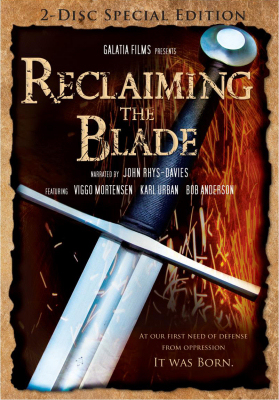 Reclaiming
the Blade Reclaiming
the Blade
Galatia Films, 2009
Reviewed by Andrew Ullrich
Reclaiming the Blade is a documentary by filmmaker Daniel McNichol
about swordfighting in the modern western world, in its various
theatrical, recreational, sporting, and martial forms. It begins
by introducing the sword as an icon of courage and honor throughout
the history of mankind, and even though the true art of its
use had died away after the Rennaissance, it still evokes these
feelings and ideas today through storytelling and theatre. The
film continues from there to talk about fight choreographers
and actors, sport fencers, and then pretend-fighters and "re-enacters"
such as the Society for Creative Anachronism, and other potentially
misleading efforts which have made it difficult for people who
have worked credibly to dispel myths and misconceptions about
real historical European swords and swordsmanship. However,
with a little patience, eventually one comes to find here the
first documentary ever to introduce this subject to a large
and diverse audience.
Throughout the film there are insightful comments and helpful
visuals for the portrayal of the story of the sword through
the ages up to modern times, such as the colorful and effective
analogy of a tree, with modern sport fencing as a mere falling
leaf from the branches and trunk of the more violent and comprehensive
art that spawned it. This and other narrative in the film are
actually word for word from John Clements' published writings
on the subject in the late 1990s as well as later material he
provided to the filmmaker. There are also interviews with some
of the most well-known people in the world whose lives revolve
in some way around this weapon, from the likes of theatrical
fight choreographer Bob Anderson and the WETA workshop on one
end of the spectrum, to Professor Sydney Anglo, the groundbreaking
academic researcher of these arts, and the late swordsmith Paul
Champagne, a pioneer in the historical methods of crafting swords.
Footage of various ARMA members are shown throughout the film,
including our director, John Clements. As an added bonus, there
is a 20-minute special feature of John and ARMA Provost Aaron
Pynenberg providing instruction on the use of half-swording
in the bonus section of the DVD.
If you're looking for a documentary whose main focus is on
the martial arts of Renaissance Europe, the ARMA
Web Documentary might be a better choice. But overall, RTB
is a very well-made film and a rare opportunity for practitioners
to show their friends and family what they do through a familiar
and engaging medium. Despite its sometimes perplexing distribution
of time to its various subjects, it does contrast European Rennaissance
martial arts with the highly restricted form of modern sport
fencing, the foreign and ritualized Asian sword arts, the pageantry
and play-focus of LARPers, and the made-for-show, ineffective
practices of theatrical swordplay. Indeed, it would be very
difficult to have men like John Clements, Professor Anglo, Paul
Champagne, and the late sword guru Hank Reinhardt in a well-meaning
documentary and still manage to misrepresent our subject.
|
|
 The
Royal Book of Horsemanship, Jousting & Knightly Combat The
Royal Book of Horsemanship, Jousting & Knightly Combat
A Translation into English
of King Dom Duarte's 1438 Treatise
Livro Da Ensinança De Bem Cavalgar Toda Sela
["The Art of Riding in Every Saddle"]
Translated by Antonio
Franco Preto (& Luis Preto)
Edited by Steven Muhlberger
Chivalry Bookshelf
ISBN: 1-891448-11-0-5, Hardcover, 180pp, 1st Edition, 2005
Review by J.L. Hull
It was both pleasure
and pain to read this book. The pleasure derives from this being
a brave and valid English translation from Portuguese of a significant
Renaissance mounted combat source by a modest yet accomplished
modern horseman. The pain derives from this being a needlessly
and wincingly flawed English edition of a significant Renaissance
mounted combat source, due to the bungling and/or indifference
of an acclaimed modern professor and/or its dubious modern publisher.
I should like to
deal with the negative first, get it out of the way, then deal
with the positive, which I am happy to say, far outweighs the
other. It seems that it is enough for some experts to attach
their names to another’s project without care for whether
that other person is well-served by such experts. In other words,
did the expert actually do what was within his/her power to
bring correction and guidance to the project, and thus serve
the other? Thus stated, it is quite sad to say that a chivalry
& tourney scholar whose own work I respect, Muhlberger,
was obviously negligent in his editorship on behalf of Preto.
Really, Muhlberger should have secured the correctness of this
project with actual editing, instead of allowing it to go to
press rife with errors. However, blame also should go to Brian
Price who, for all his talent at self-promotion and book design,
seems to care little whether some authors are well-served by
his publishing, as long as everything looks attractive to the
target-market. I write this as someone who has agonised while
editing works by both native and foreign speakers of English,
due to the heavy responsibility I have felt to help them get
things right.
The editorial laxness
is readily apparent, as Preto’s English translation suffers
from frequent and distracting errors of grammar and syntax throughout
the entire body of the work. Some is to be expected, and allowance
for author’s “voice” should always be made,
but this situation is rampant and perforce the reader constantly
must struggle with confusion, because an editor did not do his
duty. Moreover, there is the specific issue of a certain word
– “wound” (to injure) – for which again,
Preto is blameless whereas Muhlberger & Price are not, about
which Preto should have been advised, so that he may not have
used “wound” as broadly as he did. This seemingly
small thing led to misinterpretation via the translation and
footnoting. Indeed, Preto does use “wound” correctly
to speak of severely injuring in order to kill prey while one
hunts. However Preto, as allowed by Muhlberger & Price,
applies “wound” to a situation that is basically
blunt rebatre-melee at tourney, which lets him imply quite strongly
in text and in footnotes that the relevant weaponry were sharpened
swords for cutting, wherewith opponents presumably wounded each
other in bloody manner at tourneys of the time. This is quite
wrong, as confirmed by accounts of 14th-15th Century tourneys,
where extra-heavy bloated armour, cage-helms and rebated blunt
swords or wooden clubs/maces were utilised, yet it seems that
no one responsible (i.e. Muhlberger & Price) had the decency
to inform Preto of that. Some editor should have suggested “stun”,
“punish” or even “clobber” in that context.
Nor did anyone have the decency to inform Preto that “wound”
was the wrong term for describing how to spur a horse effectively
– someone should have suggested “compel”,
“inflict”, “sting”, “harrow”,
“goad” or even “pain”, but not “wound”.
Presumably, Dom Duarte had great fondness for horses, and Preto
surely has great fondness for horses, such that the mistranslation
served neither the utility nor the truth of what those two gentlemen
mean to convey.
For the positive
side, which makes this book quite worth reading and studying,
there is so much that Dom Duarte tells us which is revelatory,
and I am thankful that Preto did us great service here in the
English-speaking world by translating Bem Cavalgar for
us to learn. Bravo! Dom Duarte (1391-1438) was a King of Portugal,
warrior and horseman who chose to write a treatise about how
one should fight on horseback, most of it applicable to tourney
but arguably applicable to a great extent in equestrian duel
and/or battlefield. To do him honour, the modern Portuguese
horseman Antonio Preto obviously went to great lengths to present
the lore of Dom Duarte in a manner consistent with the original
intent of the 15th Century author even as he lays it out it
as methodically as possible for the modern reader. Preto writes
with authority and knowledge of Portuguese and of horsemanship,
and he engages the reader with his candor and comprehension.
It would also have been nice to have a transcription, but just
having a translation of the work is better than nothing.
Dom Duarte presents
his advice about horsemanship combined with observations about
qualities such as will, power, strength, fearlessness, safety,
quietness and ease of both rider and steed, also relating such
to proper social behavior and duty. Perhaps some readers would
weary of all this throughout the book as preachy, but I found
it sincere and even uplifting. He states why knights and squires
should be equestrians, how one should care for one’s wealth
and health in order to do this, and how one needs to have proper
bearing to carry it all out.
Dom Duarte describes
and distinguishes between the five typical riding styles of
his Portugal, the first style bravante as most typical,
the second a related style favoured in England & Italy,
the third a related archaic style, the fourth style gineta
from the Moors, and the fifth style bareback. He advocates that
a rider should know how to do all these styles of riding, whatever
one’s preferred saddlery. He goes into great detail about
all these, and the rigging of the stirrups and strapping, and
their proper tacking. He tells how to stay mounted by proper
carrying and moving of one’s body, how to ride steady
and relaxed, ready to strike correctly in the action of a fight,
and the use of one’s whole body in cueing one’s
steed.
Moreover, he offers
instruction on hunting and on wrestling on foot translation
of that short section was done by Preto’s son Luis), but
curiously not on horse. Although the specifics of tourney and
battlefield certainly differed, it is laudable that he seems
to advise vigor at tourney and in one’s training, presumably
to make one effective at both duel and battle. Dom Duarte also
offers philosophical and moral advice which he argues is inseparable
from proper success at marital arts.
Dom Duarte describes
the three main ways to bear the spear on horseback, with variations
thereof. Such directly contradicts some of the simplistic and
denigrating analysis by some modern historians that European
knights were technically monotone equestrians. Dom Duarte tells
of how to move the spear efficiently and strongly to stay ahorse
and to deliver the best strike one can, especially at the moment
of impact with the foe. He goes into detail on the sensible
ways to pursue game from horseback, so as to make the kill yet
prevent injury to the horse (and thus the rider), plus how to
properly throw spears from horseback. Preto’s translation
of all this really makes it come alive.
Dom Duarte speaks
of “wounding” with sword while ahorse. Despite the
previous critique of vocabulary vis-à-vis context, the translation
by Preto conveys the sound kinetic sense of those moves, how
if properly done, one then transfers the force of both the self
and the horse through any of the defined four main strikes into
the foe. Such a matter of use of force certainly applies to
both a blunt rebatre and to a sharpened sword.
One interesting
thing sociologically is how often Dom Duarte tells you how one
does or should appear to court and/or spectators when doing
a given move. Such advice may be cynically ascribed to some
sort of vanity, although there seems more to it. What seems
unspoken by him is that it is important for a leader to maintain
a certain bearing, thus leading to extraordinary ability, in
order to keep his followers in high morale and consequently
in willingness to be led. However, Dom Duarte shows he realises
the complexities of life as he admits sometimes folks are not
what they seem, as someone who seems uncouth or weak to conventional
appearance may actually prove himself a talented and powerful
man when called to action, and of course vice-versa. Although
his work was actually unfinished at the time of his death, Dom
Duarte does give a summary of his main points as are relevant
to the most common dangers and disasters which face rider and
steed, and how they may overcome them.
All said, this book
was a great pleasure to read. I think that Dom Duarte via Preto
has done us great service by writing down such a good deal of
the equestrian lore for we later generations who hopefully may
gain a better understanding of how much of fighting ahorse was
conducted in late Medieval and early Renaissance Europe. So,
I do indeed highly recommend the Royal Rook of Horsemanship
(Bem Cavalgar) by Dom Duarte as translated by Antonio Preto
on its merits of content, and can honestly say it is worth reading.
|
|
 "Dueling
with Sword and Pistol: 400 Years of One-on-One Combat" "Dueling
with Sword and Pistol: 400 Years of One-on-One Combat"
By Paul Kirchner
Paladin Press. November 2004
Reviewed by Jason Vail
Even modern men
cannot escape the allure of single combat. There is something
visceral about it, something that appeals to a primal potential
for violence. Despite the stultifying effects of political correctness,
the attraction cannot be denied. Single combat, where a man
is measured in the clash of weapons and skill, remains fatally
fascinating. How else to explain the popularity of boxing, the
UFC, and the Octagon? Single combat -- and more specifically
the duel of honor -- is the subject of Paul Kirchner's new work,
Dueling with Sword and Pistol: 400 Years of One-on-One Combat.
Dueling, of course,
is age old. The Iliad celebrates single combat. In
222 B.C., the Roman consul Marcus Claudius Marcellus, nearing
50, took up the challenge of the younger Celtic chieftain Viridomarus,
and the two fought to the death between the their two armies
at Casteggio in Italy, with Marcellus emerging the victor. Scandinavian
sagas from the Viking age are filled with stories of single
combats and formal duels.
But Kirchner's focus
is on the last four centuries of dueling, when it had become
rigidly formalized in the code duello. The book is
a refreshingly realistic and unromantic look at these combats
-- how they began, growing out of real or imagined slights;
how they were organized and the men brought together; and how
they were fought.
Kirchner has done
an exemplary job of new research presenting not the regurgitated
accounts from taken from existing standard works but adding
considerable new material to the subject. For that alone he
is to be thoroughly complemented. This review focuses exclusively
on Part I of the book dealing with sword combats.
It's possible to
mine the book on many levels. You can simply take it as an exciting
series of stories about personal combat. For it is that, some
of the tales, particularly those from 19th century sources,
reading like something out of Burrough's John Carter series:
one period account gushed, "Well-tempered steel, striking its
like, gives forth a gallant, ringing tone." There is also a
gritty account of dueling in Napoleon's army, which you may
find interesting especially if you've seen the movie "The Duelists."
You can also take it as a source of fascinating tidbits of historical
information. For instance, you'll learn that in the years before
the Civil War, New Orleans was America's fencing capital, where
fencing schools lined Exchange Street and at least three of
the fencing masters were freed blacks. And the schools held
regular competitions. These salon bouts often escalated into
deadly fights with sharps. You'll learn that it was wise to
clean blood from the blade immediately to prevent corrosion.
Or, like me, you can mine the book for what it has to teach
about the reality of sword combat. For it has a lot to say on
that score, even if we cannot reconstruct combats blow by blow
What emerges is a picture that gives more than enough for any
student of historical martial arts to think hard about -- and
could settle some arguments current in Asian fighting arts circles.
One primary impression
is that these combats were vicious, all-in affairs. The combatants
did everything they could to win. By this period, what constituted
acceptable combat had been rigidly fixed and ritualized. Wrestling,
for example, was frowned upon. But in battle conventions often
were ignored. Trips and grapples were commonplace, even with
the rapier and smallsword, and struggles often continued on
the ground. Men's swords broke and they continued to fight with
the shard, stabbing their opponents with the broken blade. Pommeling
was frequent. Men fell on uneven ground and their opponents
tried to stab them where they lay. Blade grabbing was
common. It was not unusual for both fighters to grab each other's
blades even when fencing with smallswords -- not unlike the
longsword illustrations in Talhoffer -- to prevent being skewered.
Today there is great
concern about the differences between dojo martial arts and
street martial arts. Many of the combatants in Kirchner's study
were well aware of the difference between salon fencing and
"fencing of the field." If nothing else, the book drives home
the point that what one learns in the play/practice fighting
of the salon may not work with live blades. This implies that
great care must be taken when reconstructing techniques from
the historical fight books. Altogether, this is a good read,
and I recommend it to all students of swordsmanship. I only
wish that Kirchner's scope had been broader and he had investigated
earlier periods. There are plenty of accounts of duels in Medieval
Scandinavian literature that deserve inclusion. Also, I would
have welcomed an informed analysis of these fights, but the
analysis is up the reader.
In the end, though,
I do not lament the passing of the age of the duel, if the period
covered can be called that. Thousands of good men died over
trivialities, and the dueling field was often the playground
for bullies and sadists.
|
 "The
Medieval Art of Swordsmanship: "The
Medieval Art of Swordsmanship:
A Facsimile and Translation of the World's Oldest Personal Combat
Treatise"
Royal Armouries MS I.33; Jeffrey Forgeng; Chivalry Bookshelf;
September 2003; ISBN 1891448382.
Hardcover; 178 pages; colour illustrations.
Reviewed by J.L. Hull
For those not familiar, MS I.33 (pronounced as "manuscript
eye-thirty-three", and also known as the Walpurgis manual) presents
a sword and buckler fencing system from Germany of about 1300
AD. This book provides the best and only pulp-published facsimile
available of the manuscript now at the Royal Armouries, Leeds,
replete with its colourful pictures and flowing text. This helpful
version features Forgeng's insightful and reasonable facing-page
translation from the original Latin into English. He explicates
the various anonymous (Lutegerus notwithstanding) scribes and
artists who must have made the manuscript. The foreword by the
Royal Armouries sets the stage for the rest of the book, with
Forgeng proceeding to establish I.33 in its historical context.
He explains that I.33 was most likely made by a group of relatively
worldly German Christian clergymen who practiced their fencing
with male students and possibly some female students as well.
He cross-references I.33 with later derivative fight-books,
notably A.83 (1500) and Sorg/Wilhalm/von Huter (1523). In a
couple cases, I found myself disagreeing with the author's generally
discreet commentary: when he ascribes I.33's fencing to the
"ludic" rather than the martial, which is arguable to say the
least; and when he seems to ignore the distinct possibility
that sword and buckler fencing originated as early as four centuries
prior to I.33 [as 9th century Frankish as well as 11th and 12th
century Spanish iconographic evidence shows--ed.]. One may also
note how the publisher's preface amounts to needless self-promotion
which does no justice to this fine book. But such really do
not detract from what Royal Armouries and Forgeng are striving
to achieve: a significant high-quality presentation of the I.33
itself. And all told, this book is indeed that. It is so because
of minimal interpolation, relevant concise interpretation, and
avoidance of pedantry. This joint effort presents the fascinating
Walpurgis the way it deserves - leaving Medievalists, scholars,
and martial artists to appreciate and determine the truth of
its teachings for themselves.
|
 Italian
Rapier Combat Italian
Rapier Combat
Master Ridolfo Capo Ferro's Gran Simulacro of 1610
Edited/presented by Jared Kirby. Greenhill Books, Stackpole Books
2004.
Reviewed by Casper Bradak.
The straightforward and complete translation of one of the
major Italian rapier manuals of the 17th century, that by Cappo
Ferro, long considered the "father" of modern foyning fence,
is presented in a refreshingly minimalist no-frills version
that is easily understandable. Sydney Anglo noted in his Martial
Arts of Renaissance Europe, "In terms of combat technique, this
work is one of the most influential in the history of swordsmanship."
Offered in hardback with an attractive layout it retains the
original terms untranslated in order to retain their specific
intention (for which the editor has included an explanative
glossary). The original artwork is some of the best on the weapon,
leaving little room for error and omitting the need for any
dubious modern interpretation or commentary, which while useful
to the modern martial artist can be considerably distracting
and debatable. Master Capo Ferro includes his basic guards and
stances, and explanation of many basic concepts. He gives detailed
information on exact technique and the principles of this style
of combat. The techniques are also viciously effective, very
economical, and well described. This book is all business. There
is nothing fancy or foolish to a single technique. They are
all about killing or wounding your opponent in the most direct
and efficient manner possible. He includes techniques for the
single rapier, and a variety of practical off hand weapons/items
combined with it (dagger, cloak, and round shield). Many of
the plates include a grid on the floor for even more exact interpretation
of the techniques. All of the original artwork is included (43
plates) and well printed, using the entire page for each picture.
The pictures illustrate the immediate effect of the successful
techniques, with the injuries inflicted graphically depicted,
which give even more precise information on the completed positions
and angles of attack. Another interesting facet of his manual,
being that it is on the use of the "true rapier", is that he
includes edge blow techniques and advice on performing them,
where other masters discouraged them as useless or dangerous,
to oneself and his weapon. The effects of these not withstanding,
many of them are more than simple stromazzone or harassing tip
scratches. He describes them as "schything", meaning percussive
slicing action, as described by other cut and thrust masters.
While never meant to kill or even disable the opponent, against
bare flesh the cuts distracted and harassed the opponent enough
to permit a killing thrust follow-on having more success. While
one might squabble over differences with a couple of word choices,
overall this is a good translation and a good work for beginning
students of the rapier. This work should be in any rapier enthusiast's
library for the full size plates if nothing else. Definitely
a must have for anyone interested in this deadly and innovative
renaissance weapon. I can see no downside to this book, a rare
thing in my experience in regards to newly published fencing
manuals.
|
 TLC's
Great Books - Le Morte D'Arthur TLC's
Great Books - Le Morte D'Arthur
VHS Videotape. 1993. $15.
Reviewed by J. Clements
From the Learning Channel's excellent and award winning "Great
Books" program series comes this 60-minute long 1993 documentary
on Sir Thomas Malory's Le Morte D'Arthur. Beginning with the
statement, "This is a tale about power…" the somber narration
of actor Donald Southerland aptly fits the serious tone of the
program. No romantic celebration of Arthurian legends or Medieval
fantasy here, the treatment pays respect to this famous 15th
century work of literature as a mature commentary on morals
and ethics amid the tragic flaws of human character. The story
and characters reflect ideals of loyalty, integrity, the ethical
use of power, as well as important questions of the rule of
law, and the rule of our passions. The program doesn't spend
too much time on trying to unravel the historical origins of
a real life Arthur (a topic explored in other documentaries).
It instead concentrates primarily on the book as it concerns
the social and philosophical problems of the time in which it
was written--where it was received as a serious commentary on
contemporary political reality and the problem of chivalric
life. The show relates these recurring themes and psychological
underpinnings of the human struggle to modern Western civilization:
how do we make individual moral decisions in a world ruled by
the aggressive use of force? The program fits in an extraordinary
amount of material as it traces the tale's considerable influence
on later works of literature and modern entertainment, relating
it to everything from T.H. White's The Once and Future King,
to Prince Valiant, Camelot, Disney's The Sword and the Stone,
Excalibur, and even the Star Wars trilogy. Most surprising is
the contempt directed at pop culture's trivialization and commercialization
of the Arthurian tales of the Knights of the Round Table, and
the caricaturing of the figures of Merlin, Lancelot, and Guinevere.
Without being least bit pretentious, this refreshing, entertaining,
and re-watchable video is must viewing for anyone interested
in the serious study of chivalric literature and knightly values.
|
 The
Last Duel. A True Story of Crime, Scandal, and Trial by Combat
in Medieval France The
Last Duel. A True Story of Crime, Scandal, and Trial by Combat
in Medieval France
Eric Jager. Broadway Books, NY 2004. 256 pages. $25.
Reviewed by J. Clements
Recounting a little known judicial combat from 1386, this is
the best book about a single historical duel I've yet read.
Fought between Jacques LeGris, a well known squire to the king,
and a popular knight, Jean de Carrouges, this was the last trial
by combat ever ordered by a decree of the Parliament of Paris.
Following its dramatic impact and outcome, the frequency and
popularity of judicial duels declined in the following century.
In this regard it resembles the much later 1547 French judicial
combat between Jarnac and Chastaigneraye. Complete with all
the assorted social intrigue, gossip, and politics it flows
like a good thriller novel. The reader must resist the temptation
to skip ahead to see how it ends and instead let the tension
build. It definitely pays off in the end. For once a historian
also manages to get it right when it comes to descriptions of
the arms and armor as well as the combat itself. In this regard,
Jager, a Professor of English at UCLA, is refreshing in the
respect and attention he pays to these elements, refusing to
gloss over them in favor of less martial aspects. One drawback
however is the lack of indication whether or not quoted material
is at times traceable to actual historical sources or is the
author's own narration. A readable and suspenseful work, it's
highly detailed including many important rules and regulations
of Medieval judicial combats that have remained obscure. Jager
does a thorough job of laying out the circumstances of the conflict
while in the process retrieving from history's dusty memory
a description of an event worth reading about. The effort will
prove interesting not just to students of Medieval history,
but anyone who enjoys great historical tales.
|
 Medieval
Hand-to-hand Combat Medieval
Hand-to-hand Combat
By Keith P. Myers, ARMA DC. Privately published 2002.
Reviewed by Jason Vail.
When I first encountered the Fechtbücher at the ARMA website
and elsewhere, it was almost a life-altering experience to see,
laid out in book after book, grappling techniques that I had
studied in Japanese judo and jujutsu. Yet, these techniques
I saw were invented in the West and set down on paper by fighting
masters more than a hundred years, in some cases, before the
founding of the first known jujutsu ryu, which appeared in 1532.
It was immediately clear that Medieval European combat wrestling
was a complex, subtle and brutally effective combat art, rich
and flexible in its vocabulary. Questions leaped immediately
to mind: How did the European teachers differ from one another
in their battery of techniques? How they were the same? How
did the Europeans' approach to close combat differ from that
in the East? If you wanted to learn Kampfringen, what was your
best source of information? It looked like a lot of work to
find the answers.
Then I found Medieval Hand-to-hand Combat by martial artist
and Army physician Dr. Keith Myers, a Rockville, MD, ARMA member
and ARMA DC Study Group leader. Keith's book has made the study
of Medieval combat wrestling much easier. Medieval Hand-to-hand
Combat surveys the principle Fechtbücher, and in an organized
way depicts the wide array of combat wrestling techniques known
to the Medieval European fighter. Myers divides techniques according
to their purpose. He starts with fundamental or basics (although
one can quibble here and there with the designation of this
or that technique as a basic). These include tie-ups or ways
to grasp an opponent, setting up the opponent for a technique,
kicks and sweeps (he shows four), strikes, parries to fist blows,
throat holds, defenses to lapel grabs (at least nine of them),
the initial move against dagger thrusts (grab the arm), and
head locks and chokes. He follows with a section on armlocks,
which appears to be comprehensive, illustrating just about every
one I have identified in the books. I don't think any important
ones are left out.
Kieth also shows the wide variety of takedowns and throws found
in historical European grappling arts. Many of these, like the
armlocks, are also found in judo/jujutsu, such as tai-otoshi,
osoto-otoshi (tenchi nage in aikido), ogoshi (the major hip
throw), ippon seoinage (the flying mare), and more. Myers demonstrates
the counters Medieval fighters invented for defeating the throws,
as well. The large battery of leg pick-ups available in the
European systems are shown too. Myers does not neglect ground
fighting either, although as he notes, the Medieval Europeans
did not apparently do much fighting on the ground, as is common
in wrestling/grappling systems today. This probably arises from
the concern that in combat you don't want to find yourself rolling
around on the ground with someone because his friend might come
up and finish you with a knife in the back. Better to get the
guy on the ground where you can finish him with your knife.
Finally, Myers delves into dagger fighting and unarmed dagger
defense. We see in detail how wrestling and dagger defense and
dagger fighting merge, and how fundamental wrestling techniques
are to effective dagger fighting. We also see techniques advocated
by modern knife fighters, especially those coming from the Philippine
tradition, such as the hand cut. One of the book's great strengths
is that Myers illustrates most techniques by showing drawings
from more than one Fechtbuch. So, for instance, the reader can
see a single technique illustrated by pictures from the Codex
Wallerstein, Albrecht Duerer, and Fiore de Liberi.
Thus, the reader gets the sense of how widespread and well
known many of these techniques were. While Liechtenauer and
Ott are often credited with being the fathers of European combat
wrestling, viewing the same techniques drawn from several different
Fechtbücher spanning more than two hundred years suggests that
if these men were the "fathers" they probably drew on, and perhaps
systemized, a pre-existing body of knowledge that likely was
very ancient. Medieval combat wrestling had many roots.
Like any book, the work has some weaknesses. Myers includes
an index to techniques, essentially a table of contents, in
an appendix at the back. The reader might be better served if
this was up front. Also, Myers apparently relied solely on the
drawings to interpret what was intended and not the text. While
viable, this also means that he may need to revisit some of
his interpretations in the future as translations of the Fechtbücher
become available.
I also noted a few of his interpretations that are at odds
with the recently published translation of the Codex Wallerstein.
For instance, Myers interprets as a front kick a Codex drawing
in which one man has another by the arms with his foot on the
other's stomach. This is a reasonable interpretation. However,
the Codex translation (plate 81) makes clear that this drawing
depicts the prelude to the equivalent of tomoenage, a throw
in which the thrower grasps the throwee, sits on his butt, puts
his foot in the throwee's stomach, rolls back and launches the
unfortunate throwee over his head. You've probably seen this
move even if you've never practiced judo. It was a staple of
1950s action movies.
In another example, Myers interprets as a head butt a Codex
drawing showing a man grasping another's right arm with his
head close to his partner's. Again, this is a reasonable interpretation,
but the Codex translation (plate 90) makes clear that this is
not a head butt after all, but a one-arm tie-up. However, I
don't mean to suggest that Medieval Hand-to-hand Combat is chock
full of flaws. Far from it. This is a sound, valuable work.
It will serve as an indispensable guide to training. Anyone
serious about European Medieval martial arts should have a copy
in their library. This
book is also an official recommended unarmed study guide for
the ARMA.
|
|
 The
Codex Wallerstein - A Medieval
Fighting Book from the Fifteenth Century on the The
Codex Wallerstein - A Medieval
Fighting Book from the Fifteenth Century on the
Longsword, Falchion, Dagger,
and Wrestling.
by Grzegorz Zabinski with Bartlomiej Walczak
Paladin Press, 2002. 392 pp. ISBN: 1-158160-339-8. $54.95
The Codex Wallerstein
is one of the best known of the late medieval fencing treatises
still in existence. Now with the publication of this large size
book, the text and drawings are available to scholars and martial
artists in the original Middle High German, as well as in Modern
German and English translations. For martial artists, medievalists,
historians or anyone with an interest in historical arms or
self-defense, Codex Wallerstein is sure to become an invaluable
reference.
|
|
 Secrets
of German Medieval Swordsmanship - Sigmund Ringeck's Commentary
on Liechtenauer's Verses. Secrets
of German Medieval Swordsmanship - Sigmund Ringeck's Commentary
on Liechtenauer's Verses.
Sigmund Ringeck & Johannes Liechtenauer. Translated and
interpreted by Christian Henry Tobler. 416 pages. ISBN: 1 89144
807 2. First published: 2002. Chivalry Bookshelf.
In the late 14th
century, Master Johannes Liechtenauer developed a deadly form
of martial art that fully integrated sword, spear, dagger and
grappling, in and out of armour, on foot and on horseback. Founding
a school of swordsmanship that would dominate Germany for centuries,
he recorded his teachings in cryptic mnemonic verses and swore
his students to secrecy. In the 15th century, Sigmund Ringeck,
a master of the 'Liechtenauer school,' broke the secrecy and
explained the verses in detailed instructions. This is an extrnely
well-rendered work which will be a valuable addition to any
library on the subject. Though the interpretation suffers in
some areas, and the photos are stiffly rendered and display
no real sense of motion or energy in the techniques presented,
this is a useable study guide resource for any serious student.
Unfortunately, the interpretation of several key techniques
and concepts, however are far from definitive and in many areas
bio-mechanically unsound and tactically suicidal. The influence
of these mistakes on some students of the subject will no doubt
take significant effort and time to shake off. It is nonetheless
a welcome addition to available literature.
|
|
 Companion
to Medieval Arms and Armor Companion
to Medieval Arms and Armor
Edited by David Nicolle. Boydel & Brewer, 2002. $60.
This new work, edited
by David Nicolle, one of ARMA's advisors, presents several articles
by leading researchers and authorities. It has some very interesting
material, particularly on early swordmaking in Europe and new
information on Middle Eastern & Islamic swordmaking from
historical sources.
Plus one of the last articlse by the late Ewart Oakeshott.
|
 Carnage
and Culture: Landmark Battles in the Rise of Western Power Carnage
and Culture: Landmark Battles in the Rise of Western Power
Victor Davis Hanson (Doubleday, September 2001, 492
pp., $29.95)
A work
of particular interest to students of historical fencing studies
as it provides a unique perspective on the military tradition
underlying our entire Western martial heritage. Victor
Hanson offers a lively, highly readable and controversial view
of Western military tradition as being a direct offshoot of
the values inherent in Western civilization.
Click above for extended review.
|
 Viking
Sword Video – How to use the Viking Sword in Real Combat Viking
Sword Video – How to use the Viking Sword in Real Combat
With Hank Reinhardt. Paladin Press 2001
This short informal video (45 minutes) is
a useful source of early medieval sword & shield combat
recreation. Hank Reinhardt offers his interpretation of Viking
swordplay and in the process shows many valuable sword &
shield combat fundamentals in a casual and friendly manner.
The tape covers 4 simple fights: unarmored single sword,
unarmored sword and shield, lightly armored sword and shield,
and full-mail Norman style sword and shield.
The video includes a superb demonstration
of the effects of edge on edge-parrying/banging on sharp blades.
Also included are interesting test cutting examples on
shield edges, raw meat, and mail armor.
The fighting displays are above average and give an impression
of how the weapons and armor were used in the period offering
students many things to consider in their own study and practice.
While not a “how to tape” or an in-depth analysis
of Viking martial skills, it is worthwhile viewing. Paladin
Press offers it in both NTSC & PAL formats.
|
 Sword
Fighting – A Manual for Actors and Directors Sword
Fighting – A Manual for Actors and Directors
Keith
Ducklin & John Waller. Illustrated by Keith Ducklin &
Adam des Forges.
Robert
Hale Ltd, 2001. ISBN 0 7090 6703 8
Reviewed
by Jeff Basham.
This
brilliant work is a guidebook for actors, directors, living
history enthusiast, and martial artists who have a keen interest
in learning and recreating authentic European swordsmanship
styles from the past and incorporating and safely adapting them
for viable modern fight arrangements/choreography.
This
strait forward and keep it simple approach is the product of
a combined years of experiences between both John Waller and
Keith Ducklin. John Waller, having
more than 30 years of as an action arranger and historical consultant
for the stage and screen, is the Head of Interpretation at the
Royal Armouries in Leeds, U.K. and founder of the European Historical
Combat Guild. Keith Ducklin
has over 15 years of experience as a practitioner of period
fighting arts and has trained students’ abroad as well
as holding the position of Senior Fight Interpreter at the Royal
Armouries.
Written
in two parts they consist of the following: Part
One: Philosophy, by John Waller,
discusses such topics as ‘Reality First’, being
“…that all techniques taught should have their basis
in those realistic options available to the combatants with
the weapons at their disposal.”(Pg 15).
The author then continues on to aspects of Body Mechanics
(Eye Contact, Balance, and Intent) and covers issues in regards
to Clothing and Protection and Character and Motivation.
Part
Two: Training, by Keith Ducklin, brings analysis and descriptions
of techniques. Aided with over 130
superb illustrations by Keith and Adam des Forges, the author
gives a straight forward step by step instruction in which you
can learn special techniques to a particular weapon type.
Keith starts off by establishing the crafts terminology,
addresses types and methods of attack and defense and footwork.
From there come five arrangements that consists of the
following: Late Medieval Two-handed Sword, Late Medieval Hand-and-a-half,
16th century Single-handed Sword and Buckler, 16th
& 17th century Rapier and Dagger, and late 17th
century Transition Rapier and 18th century Small
sword.
In
addition to the above, you will also find within its 192 pages
gems of information including how to use character, costume,
period and setting in the staging of arranged performances or
fight scenes. Add to this John Waller’s
method of Fight Notation, which includes some of his past works
including Monty Python and the Holy Grail.
This
work is a must read for any aspiring actor, director looking
to improve upon historical accuracy rise above the status quo,
living history enthusiasts (actors in their own right) and even
martial artist who may gleam aspects that can be used in a training
curriculum or get the chance to one day be part of a theatrical
arrangement.
|
 Martial
Arts of the World – An Encyclopedia Martial
Arts of the World – An Encyclopedia
ABC-CLIO
Press, 2001. Tom Green, Editor.
Reviewed by John Clements
Named
"Outstanding Reference Source" for 2002 by the American Library
Association, and a New York Public Library "best reference",
this detailed two-volume work edited by anthropologist and ARMA
consultant, Prof. Tom Green, is a major and unique contribution
to martial arts reference. In
contrast to similar works in the past purporting to describe
the “world” of martial arts, this works encompass
all cultures of the globe –and for the first time includes
significant material on historical European martial arts. The
volumes also exclude sporting forms and concentrate specifically
on combatives (systems of hand to hand fighting).
Ironically, the cover image collage features two sport
fencers –despite the activity purposely not having been
included.
The
no nonsense entries (each approximately 1000-5000 words in length)
cover more than 800 pages and are concise with many illustrations.
Happily, among them are topics one would not normally expect
to find in a book of this sort: gladiators, knighthood, chivalry,
heraldry, duelling, masters of defense, stage combat, stick
fighting, Medieval and Renaissance swordsmanship, Savate, La
canne, Sambo, gunfighters, police training, history of women’s
involvement, etc. ARMA members
Gene Tausk and Advisor Ron Harris have several pieces in the
encyclopedia ranging on topics from Gladiators to African to
Filipino martial arts. My own contributions
include several on European fighting skills and martial heritage.
While
informative and worthwhile, my pieces suffer however from being
somewhat disjointed and jumbled and read a tad repetitious (I
went through it with a red pen). Written over two years ago,
they contain not a few errors and mistakes of master’s
names, text dates, and technical terminology (such as guards
and stances for long sword, and the names of a few blade forms).
Part of this problem I confess was my own urgent and desperate
need to “get in as much as possible” on each subject
within the limited space offered. Other
problems were to due to publishing and editing difficulties
and fallible research sources. Anyone
who has written professionally knows the problems that can arise
between what you intend and what actually gets published.
I'd give my sections a B- overall. These excuses aside,
and despite some inaccuracies and failings, the entries make
their points solidly about Historical European Martial Arts
and are useful references.
The
encyclopedia’s many entries also focus where appropriate
on the current status of the arts, describing not only the subject
and its origins, but their transformations.
A sociological theme runs throughout the work and is
a pleasant departure from the more familiar sensationalist approach
found in earlier dictionaries and compendiums of “world”
martial arts. Some of the valuable
material comes from descriptions of the relationship of each
martial art to folklore, myths, and political and social context
–no doubt reflecting the editor’s background in
these subjects. Overall, the Martial
Arts of the World encyclopedia is an important reference
work that stands above the typical Asian-centric view of the
subject.
|
|
Sword
in Hand – A Brief Survey of the Knightly Sword
Ewart Oakeshott, Arms and Armor Inc., Minneapolis, MN, 2001.
Reviewed by J. Clements
This
remarkable little book, long in the making, is a compilation
of more than 13 articles written in the 1980’s by noted
European sword authority Ewart Oakeshott. Put together
into book form by Craig Johnson and Chris Poor of Arms &
Armor and directors of the new Oakeshott Institute for the study
of European swords and conservators oh his collection. The chapters
originally appeared separately during the 1980’s as little
known articles in “Gun Report Magazine”. For
the vast number of readers unfamiliar with those valuable articles
valuable the book is a welcome addition to the source literature.
Johnson and Poor worked long to bring this material top a wider
audience and even a cursory glance will give the reader reason
to understand why. In his writings Oakeshott updated material
presented in his many famous books from the 1960’s.
In my own writings I myself have relied much on Oakeshott’s
articles that make up this work and recommend this new compilation
as a must have for the student of the sword. Mr. Oakeshott,
long an inspiration and consultant to ARMA, presents a wide
range of material in his chapters that includes personal observations
and recollections on antique historical swords as well as a
range of impressions from his own personal and other private
collections. In his usual casual sincere and fascinated
approach, Oakeshott’s profound expertise comes out clearly
in each chapter. The book, dedicated to John Waller,
“who makes this live”, reads very pleasantly as
an exploration of the subject with the sword not just as a historical
or cultural or artistic object but as a working tool in a historical
context. Aspects of Viking lore, chivalry, knighthood,
tournaments, battles, Froissart’s Chronicles, and judicial
duel are all touched on. Oakeshott’s subject matter
ranges from the Vikings and early Medieval short swords to great
swords and two-handers of the 1400s as well as cut-and-thrust
arming swords. Among the material he offers sections on
short swords, knightly long swords, and information distinguishing
between Medieval two- hand swords and the later Renaissance
two-handed swords. It’s illustrated with many original
drawings by the author and dozens of excellently examples of
pieces once in his own or other collections. Sword in
Hand is a wonderful little book the presents the best of Oakeshott’s
lifelong and sincere love of swords. The book is another welcome
addition to the subject literature from the “Dean of Swords”.
|
|
Blood
Red Roses 
The Archaeology of a Mass Grave from the Battle of Towton
AD 1461
by Veronica Fiorato, Anthea Boylston, Christopher
Knusel. Oxbow Books, Ltd. 2000.
Reviewed by Hank Reinhardt
This
is a most important book for the serious student of arms and
armor and of history. One hundred years after the Battle of
Visby, in 1361, there was the Battle of Towton.
Visby was important not so much as a turning point in
Swedish history, but because the mass graves there survived
to the present day and form an invaluable archeological resource.
So it is, too, with Towton in England. A mass grave was recently
excavated, there was intense an intense forensic study of the
skeletons that were unearthed. Although
there are interesting chapters on Archery, Weapons and Armor
by John Waller, Graeme Rimer and Thom Richardson, the real value
of the book is the detail regarding the victims. These appear
to be average soldiers of the period, and we learn the general
condition of their health, their teeth, their height, and previous
wounds. It is extremely interesting, and confirms many things
that have long been suspected. One of the most important is
that people were tough and strong, and not near as small as
many like to think. The one flaw in the book is the attempt
to pretend that the victims were not murdered. One idea is that
they were killed while fleeing the battle. They had thrown away
there helmets when a detachment of cavalry attacked. This is
why all the wounds are head wounds. This whole idea falls apart
when you consider that the dead had received multiple wounds
to the head. A horseman is not quite
able to deliver a number of blows to the head, as the recipient
would usually start falling, and it would be quite difficult
to reach down and continue to deliver blows. However multiple
blows to the head are very likely when a group is being killed.
It is easy to imagine the armed men attacking and hitting hard
and often, and even striking while the victim is on the ground.
This isn’t “fighting” in combat, it is killing,
it is butchering. Another conjecture was that the men had fallen
in the battle, and as the waves of troops passed over them,
they were again struck in the head. That doesn’t make
any sense either. Occam’s Razor applies here. They were
simply prisoners that were killed. The Wars of the Roses were
notoriously brutal, as are all civil wars, so one shouldn’t
be surprised at this action. This was the 15th century,
and people behaved differently than they do today. Even today
such things happen, witness Bosnia and Africa. But this is merely
a quibble on my part. This is a book that I wholeheartedly recommend.
Regardless of how the victims met their fate, it is a very important
book.
|
|
Medieval
Military Costume – Recreated in Colour Photographs
Europa Military Special No. 8. Gerry Embleton. The Crowood
Press, UK, 2000. $22.95.
Reviewed by J. Clements
Gerry
Embleton, co-author of the superb “Medieval Soldier”,
has done another outstanding job. Showing
an array of recreated historical source illustrations and artwork,
this book covers all the important key elements of late medieval
garb and equipment –shoes, headwear, under garments, body
wear, helms, and armor. This is
the best of what re-enactment is all about. The book provides
splendidly depicted sections on garments worn under armor and
on historical footwear and clothing. The
photos are superb and specifically taken to show off clothing
or armor. The pictures offer a world of examples and inspirations
to draw on. The Focus is mainly
on Swiss, German, Italian, and English men at arms and knights
of the mid to late 1400s (one of the most popular periods for
living history reenactment and among the liveliest for martial
arts). The daily wear of civilians
and women folk is also included as is some on earlier and later
periods. The reader can drool in
envy at the detailed accoutrements of modern examples of period
soldiers and warriors, as well as use the many facts, sources,
and suggestions given to assist in their own efforts. Though
not large, and not heavy on text, this book is gorgeous. It
is an absolute must for anyone interested in eventually adding
ameticulously reconstructed and historically accurate ensemble
to their experience of historical European martial arts…the
other side of the coin.
|
European
Weapons and Armour – From the Renaissance to the
Industrial Revolution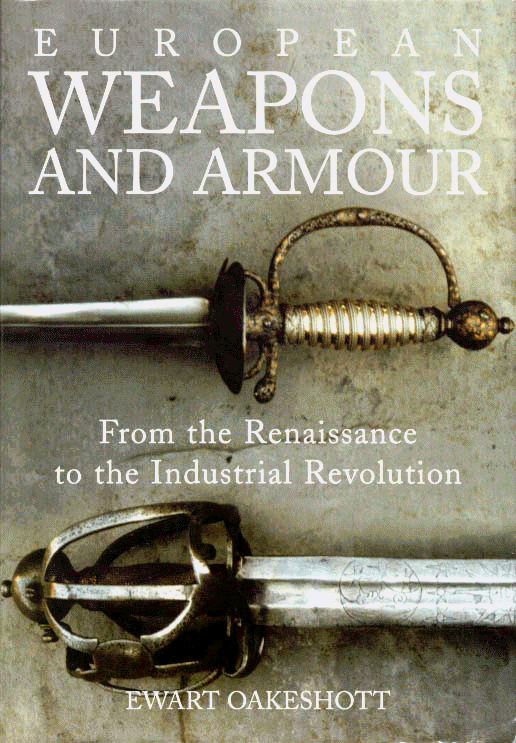
R.
E. Oakeshott. (Lutterworth Press, 1980). Boydell reprint 2001.
$40.
Another of Oakeshott's, this is likely the best book available
on arms and armor after the Middle Ages and contain a wealth
of information on renaissance armors and sword forms.
Just reprinted this hard t come by title is now available
once again. Its many chapter son armor, helms, swords, rapiers,
and more covers an amazing dearth, It is one of the few books
to address the distinction between civilian and military swords
of the renaissance and distinguish between sword sand rapiers,
as well as properly qualify basket-hilted blades and broadswords.
The reader will spend a great deal of time studying
the depth of information provided.
|
|
Viking
Weapons and Warfare
J. Kim Siddorn. Tempus, UK, 2000. $27.
Reviewed by J. Clements.
Reading
this excellent work was pleasant and enjoyable. Written by one
of the most experienced reenactors of the Viking period, with
a lifelong interest in the subject, the majority of the book
consists of about 140 pages covering history, iron, spears,
shields, armor, and swords. Siddorn
does not bother to just rehash material from other reverence
works on Viking arms or armor, but instead provides first-hand
information gathered from re-creation of the subject based on
extensive research and hands-on study.
The book is nicely illustrated with dozens of lively
black and white sketches and 16 pages of color photos.
Swords are covered in roughly short 15 pages, spears
in about 7, armor and helms each in just 6, and shields in 20.
The shield section also contains information on construction
and statistics on dimensions of known archaeological shield
finds. Other chapters cover history,
money, sword sheaths and other equipment.
There is even a wonderful section on Viking ships and
sea travel, again from experience in reconstructions and reenactment
of actual replica ships travel. One
drawback perhaps is that reenactment combat is covered in a
mere 3 pages and then without much explanation as to its limitations
as martial study or historical research.
No accounts referencing combat from period literature
is included either. The author however
does very well in distinguishing between current factual evidence
from theoretical propositions, relating his own reconstruction
insights to known historical research. Siddorn’s casual
writing style reads easy and his theories and comments contain
a few real gems (which excuse some of his minor errors in sword
typology or his referring to Viking blades by the 17th
century term “broadsword”).
His enthusiasm, sincerity, and passion for his subject
comes through clearly as does his high degree of familiarity
of his subject. This is a fun and lively book useful to anyone
interested in Viking reenactment, medieval arms, or early English
history. We need more good titles like this.
|
The
Myth of the Sword
By Hank Reinhardt. Paladin Press Video,
VHS 2001.
The first in a series of videos exploring the reality and the
romance of historical European swords and weaponry from the premier
expert on the subject in North America and ARMA founder. Mr. Reinhardt
explains their form, function, attributes, capabilities, and misconcpetions.
Material focuses on the early Medieval sword & shield and
includes test-cutting. Finnaly, a reliable source that shows it
like it is without all the Hollywood nonsense and duelling sport
cliches'.

|
 "The
Martial Arts of Renaissance Europe" "The
Martial Arts of Renaissance Europe"
By
Sydney Anglo
Exclusive
ARMA preview & review
here.
|
|
"Medieval
Combat: A 15th Century Manual of Swordfighting and Close-Quarter
Combat"
Hans Talhoffer. Translated by Mark Rector. Greenhill Books/Lionel
Leventhal; (September 2000) ISBN: 1853674184. This long-awaited
modern English edition of Talhofer's 15th century Fechtbuch
is finally available! Excellent resource! Includes more than
260 of Talhoffer’s famous plates from his edition of 1467.
This is an excellent resource that will be valuable for all
students of historical fencing and Medieval martial arts for
years to come.
Review by Stefan
Dieke:
Although the book only claims to be a translation of a German
fencing book written in 1467 by Fechtmeister Hans Talhoffer
it's much more than that. It provides an interpretation of this
more or less cryptic source by an experienced swordsman and
thus makes it much more valuable for beginners and advanced
practitoners of the Long Sword than a mere translation of the
texts provided by the first edition which had been edited by
Gustav Hergsell in 1888. Mr. Hergsell only partially translated
the medieval german texts which he found in the original manuscript
into moderen german but left those parts untouched, which he
was not able to translate. Thus in his edition there was an
obscure mixture of medieval and modern German. Mr. Hergsell
doensn't seem to have cared too much for this problem. He has
published three different manuscripts written by Hans Talhoffer
and still stated that there was not much art or skill in fencing
with the long sword. From his point of view the epee was the
ultimate fencing weapon and fencing itself archieved it's height
at the end of the 19th century.
Luckily for all the readers Mr. Rector took a different approach.
Instead of just translating the texts from the 19th century
he analysed the pictures and the transcription of the original
texts and tried to find out what they described. Interchanging
informations with other practitioners of the Long Sword he was
able revive the deadly effective system of fighting with the
Long Sword and other (some rather strange) weapons of 15th c.
Germany and to show this on the plates from an original 15th
c. Fechtbuch. Where there's need he provides additional information
in the form of endnotes. The book is rounded of by a short but
precise description of the principles of german Long Sword fencing
and a brief overview of the weapons described in the book and
their background. For those who can read german Mr. Rector also
includes a transcription of the
original text.
This book is definitely the best edition of Talhoffer's manuscript
we have worldwide. For Fencers with the Long Sword it provides
invaluable information, no matter if they are beginners or advanced.
For all other readers it may give a correct impression about
fighting techniques and judicial combat of the 15th century.
If you're used to what Hollywood or
Ren-Faires offer, reading this book may be an eye-opening experience.
|
|
"Nobles,
Knights, and Men-at-Arms in the Middle Ages"
Maurice Keen, The Hambledon Press, London, 1996. ISBN: 1852850876.
A collection of 14 essays by expert medievalist Maurice
Keen's essays originally published between 1962 and 1993 that
deals with both the ideas of chivalry and the reality of warfare.
He discusses brotherhood-in-arms, courtly love, crusades, heraldry,
knighthood, the law of arms, tournaments and the nature of nobility,
as well as describing the actual brutality of medieval warfare
and the lure of plunder.
|
|
German Swords and Sword Makers
- Edged Weapons from the 14th to the 20th Centuries
Richard H. Bezdek
Paladin Press, January 2000, ISBN 1-58160-057-7
Reviewed by J. Clements
Richard Bezdek,
sword collector and author of titles on American swords and
sword makers, has done a highly detailed job of compiling a
range of table, lists, charts, and information on a subject
that has received less attention that it rightly deserves. It
should prove a valuable aid to collectors, curators, and aficionados.
Covering mostly the famous Solingen region of Prussia (known
for their "running wolf" logo) which at one time was the world's
largest producer of swords, this reference work is a useful
text. Covering swords mostly of the 17th, 18th, and 19th centuries
it features many drawings and pictures from noted German sword
author Gerd Maier. Over a hundred pages are offered on sword
makers, their lineage, region, with dozens of pages of sword
makers marks (a long needed reference guide). The book also
includes many sections on German history and blade manufacturers,
German sword exporters, translations of German words, and chapters
covering swords of Prussia, Bavaria, Wurttemberg, Saxony, and
Austria. Finally, about 75 ages of photos and sketches of German
swords are included. This reveals a good cross-section of just
what a wide variety of forms were in use. However, these depict
mostly all hilts of military sabers, cutlasses and actual broadswords
from the 18th and 19th centuries. Given that this is a essentially
a reference work, no information is provided on the blade forms
themselves (which is especially disappointing to students of
swordplay, given that blades can have very different cross sections
at the foible than at the forte). On the down side, it appears
little attempt was made to include Medieval swords or the wide
variety of German blade forms of the Renaissance. Surprisingly
no effort is made to classify or categorize historical German
sword such as Messers, Dussacken, the many styles of Langenschwert
(long-sword), Dopplehänder/Bidenhänder ("both" or "double-hander")
and Zweihänder/Schlachterschwerter ("slaughters-swords"). Distinctions
could have been made among the Grosse Messer or Zwiehand sabel,
the Panzerstecher or Dreiecker (estocs), and
types of Paratschwert ("parade-swords"). Comments on
the many sword forms depicted in the historical German Fechtbuecher
(fighting manuals) would also have been interesting. These omissions
may be the collectors' approach to the subject as such weapons
are very rare to obtain and less information is available on
their makers. The work also does not include very much material
at all on rapiers and none on small-swords or dress swords.
The book also makes one big mistake in omitting the major large
government manufacturer of Pottenstein. It also erroneously
declares the Klingenthal region was under German control from
1815-1918, when it fact it only came under their control after
the Franco-Prussian war in 1870. While less than complete in
some respects and aimed at the collector and curator, this reference
work still makes fine addition to any European-sword fanatic's
library.
|
|
Medieval Warfare – A History
Edited by Maurice Keen. Oxford University Press, 1999.
ISBN # 0-19-82-0639-9. Reviewed by ARMA staff
Twelve expert scholars
contributed their know-how to produce this new illustrated book
that explores 700 years of European warfare covering the era
of Charlemagne to c. 1500. Divided into two parts it focuses
first on the chronological experience of Medieval war, and then
thematical developments in Medieval war. Covers the Vikings,
Crusades, Hundreds Year War, etc. as well as investigates fortifications
& sieges, armored cavalry, mercenaries, gunpowder, shipbuilding
and navigation. Gives the reader an overall impression of where
and when plus the social experience and cost of warfare in the
period while making warfare and its ramifications the central
idea of the Middle Ages. A great addition to the subject and
one that adds new ideas and thoughts from different modern historians.
The illustrations could have been more diverse, but the short,
concise, independent chapters make this a useful and easy read
for both new students or learned ones alike.
|
|
 Siege:
Castles at War Siege:
Castles at War
Daniel Diehl, Mark Donnell. January 1999. Publisher: Taylor
Publishing Company. ISBN: 0878332138.
A companion to the
Discovery Channel's documentary it examines in how castles shaped
medieval warfare and society. A lively book with over 150 color
photos of reenactors participating in various aspects of a late
Medieval siege. It expands the programs material significantly
and adds glimpses into seldom depicted sides of Medieval siege
warfare, an activity central to warfare of the period. The commendable
use of living-history groups to illustrate the text creates
a greater sense of reality for the subject. A light but
useful and entertaining work.
|
|
Arms
& Armor of the Crusading Era 1050-1350 
Vol. I Western Europe and the Crusader States.
David Nicolle. 19988/1999 reprint by Greenhill Books UK, London/Lionel
Leventhal; ISBN: 1853673471 (Stackpole
Books USA).
Reviewed by J. Clements
An amazing work. Comprehensive and huge. Over 600 pages, with
over 2000 drawings. Presents account of armies, arms, equipment,
of the period based on archaeological and pictorial sources.
A rare book now reprinted and very worthwhile. The author is
a leading historian of the Middle East and Islamic military
history. Vol. II covers Eastern Europe and Asia.
|
|
The
World of the Medieval Knight
Christopher Gravett, Illustrated by Brett Breckon
Peter Bedrck Books, NY 1998/1996. ISBN 62774
Reviewed by J. Clements
Medieval subjects
tend to be one of the few areas where children’s books
when done with care and style also end up being a useful reference
even for adults. This delightful little work is one of those
rare gems. It is an extremely colorful and pleasant presentation
of castles, and armor, and feudal society with detailed and
highly accurate drawings and schematics of late medieval armor
and weapons. Whether for a youngster with a keen interest in
history and knighthood or the serious student, this is a fine
addition to your library.
|
|
 Anglo-Saxon
Weapons & Warfare Anglo-Saxon
Weapons & Warfare
Richard
Underwood, Hardback, 159 pages, $29.99, Tempus Publishing Ltd.
1999, ISBN 07524 1412 7
Reviewed by J. Mark Bertrand
The reenactment
movement in the UK and Europe has produced a recent number of
worthwhile books on Medieval weapons and warfare. The latest
work, Richard Underwood’s Anglo-Saxon Weapons & Warfare,
makes use of archaeological evidence, literary sources and practical
experimentation to present a detailed picture of Anglo-Saxon
weapons and fighting methods.
The book
opens with a discussion of missile weapons, from spears to slings,
then moves on to consider hand-to-hand combat weapons like the
sword and axe. Information on the construction of each is outlined
along with numerous supporting diagrams illustrations. Photo
sequences suggest intelligently, if somewhat stiffly, how the
weapons would have been used, but stop short of attempting a
more systematic reconstruction. Underwood uses the later Viking
sagas to supplement Anglo-Saxon sources where they are sketchy
—on the use of the sword, for example. Fighting an opponent
armed with a shield, blows will fall on the head, the neck and
shoulder opposite the shield, and the lower portion of the leading
leg. One of the photographs illustrates a countercut against
the opponent’s sword-hand after the attack is warded with
the shield. The combat reconstruction is not extensive, but
it is well presented and fairly realistic.
Underwood
touches on all the major archaeological evidence in his discussion
of weaponry and subsequent treatment of armor, and brings it
all together in the concluding chapter on the nature of Anglo-Saxon
warfare. Throughout, Underwood never strays too far from the
evidence. When he offers inferences based on personal experience
—during his discussion of the value of different sizes
of shields, for example —he offers common sense interpretations
that are consistent with, if not explicit in, the sources he
relied on. This work represents another example of the useful
insights that result from the collaboration between the scholar-researcher
and the physical interpretation/reenactment community.
|
|
 The
Cutting Edge - A Practical Guide to the Use of Highland Weapons:
The Broadsword and Targe The
Cutting Edge - A Practical Guide to the Use of Highland Weapons:
The Broadsword and Targe
by Larry L. Andrews, 1995/98 past & Present Enterprises,
Ridgeley, WV.
ISBN 0766367200. $11.
Reviewed By J. Clements
This interesting
little booklet of a mere 42 pages consists of ten short sections
covering guards, blocks and wards, footwork, striking, grips,
basic cuts, lessons, and training tips. It includes a handful
of simple but effective sketch illustrations of postures and
actions. Right off, it states it is a "manual on the proper
use" of the title weapons. Although very short, it is written
with sincerity and a clear martial spirit --and that on its
own deserves respect. The Scott broadsword and targe is not
my field of specialty, however it is close enough to the use
of the medieval sword & shield in universal principles as
to allow myself a good deal of room to consider the material
presented. I did not want to be intentionally critical of the
author’s effort or results, and I would much rather end
up learning something new. At the least, the author clearly
understands the necessity of using the flat to parry with and
knows about using the face as well as the edge of the shield
in parrying. The footwork chapter itself is also actually pretty
good.
Strangely, the booklet
doesn’t offer any background on the subject weapons themselves
such as describe their origin, development, history, or conditions
of use by Highland warriors. Perhaps this is already considered
generally known by the book’s Scottish heritage audience?
Regardless, the limited approach reduces the overall value of
the work. In fact, one complaint I have is that it’s all
written almost too casually, which makes appear as simply a
student’s training notes or an instructor’s brief
class outline. It also doesn't really discuss anything on blade
characteristics, weapon construction, handling aspects, hilt
configuration, etc. Cuts are covered but they surprisingly include
diagonal and vertical descending strikes as being the same and
do not even separate between left and right versions. The targe
is a small round shield, yet is its use is mentioned for only
two blocks and a handful of minor actions. No mention is made
either of its classic center-spike. He also does not discuss
its origins or period of use.
Fortunately, the
author does avoid professing most of the various common myths
and familiar misconceptions about European weaponry --and with
the mass of misinformation readily available, this alone is
an accomplishment. Of course, I did not agree with all his theories
and findings, but I do think it is easy to see how they were
reasonably arrived at and where they have merit.
I can say without
doubt that I recognize and respect the author’s methodology
of reconstructing his interpretation of the use of these weapons.
It’s obvious he sparred and trained, read historical sources,
tested their instructions, practiced again, and followed his
instincts to discern a general method which he then set out
to explain with confidence. Indeed, this is an admirable, commendable,
and reasonable way to proceed in reconstructing and replicating
a reliable facsimile of a lost historical fighting art. Sadly,
there was no mention of the important element of test-cutting
with sharp blades (or of just drilling and exercising with blunts
or wooden weapons).
The publication
also did seem somewhat too loose with its amalgam terminology,
and would have been better served again to have used additional
source material by other 18th &19th
century authors (such as those from an array of related books
on similar broadswords and cutlasses by C. Phillips Wooley,
C. Roworth, John Taylor, H.C. Wayne, J.M. Waite, Alfred Hutton,
and Antoine J. Corbesier).
It’s possible
to see where the author over generalized somewhat from his references,
several of which reflect fighting methods and styles and even
blade formss quite unlike the Scottish one of his subject (i.e.,
Lebkommer, Sutor, Meyer, Talhoffer, Capo Ferro, etc.). Some
of his interpretation of these manuals suffers and is even superficial
(focusing on postures rather than on the whole form). Additional
sources (such as Swetnam, Pallas Armata, Castle, Burton, and
others) would have been of more benefit in supporting his ideas
if he better understood their weapons and styles or included
more of them. His ideals on the "low ward" and "on guard" are
almost incomprehensible.
Still, while limited
in comparison they are legitimate and understandable source
material for supporting a basic system of broadsword & targe,
especially when the Scot weapons themselves are fairly simple
and without any sophisticated method of their own. Still, he
perhaps tried a bit too hard to force analogies or synthesize
ideals among unrelated historical manuals when in fact they
reflect wholly different philosophies of fighting.
The most disturbing
part of the pamphlet however, is an odd comment about how "the
iron clad knight stood erect with a straight back to maximize
the force of his attack against his enemies armor", and "while
a warrior clad only in leather had to use crouching stances
to diminish his total target area". This kind of unsubstantiated
nonsense reveals the author’s profound misunderstanding
of fundamental aspects of medieval fighting and weapon use and
serves to undermine his credibility. Still, some factual errors
cab be overlooked if his other judgments otherwise seems sound.
But another strange comment reads that it is not true that there
is "a standard method of sword tactics", followed later by a
statement that the reader should seek to master tactics appropriate
for his weapon" so as to "be able to recognize when they are
losing". Hunh? Statements like these are just confusing.
Overall though,
this short work does present some fundamental advice that while
perhaps not so detailed or eloquently written, is generally
sound, reasonable and undoubtedly acquired directly from experience
in sparring and fighting. The pamphlet also states it is volume
1 of a supposed 5 volume set on Highland weapons that includes
(or will include) editions on two-handed claymore, lochaber
and sparth axe, and also padded weapons (presumably sparring
gear?). Oddly, it also makes the claim the author has "20 years
of research into old manuals as well as more than 25 years of
actual field combat." I suppose by this they mean simulated
sparring?
In conclusion, the
practical advice offered on the title weapons while legitimated
in principle, is hindered by lack of supporting information
and an assortment of minor mistakes and historical errors. This
is forgivable though, and given the scarcity of respectable
titles on Western fighting arts I for one would not mind seeing
more in the future from this author. He seems to have some genuine
insight waiting to be refined and articulated. As a writer on
historical Western martial arts myself, I am all too aware of
how a person’s fighting knowledge and understanding of
weapons skills often cannot come out easily in words. So then,
while it is possible to pick this booklet apart, for a mere
$11 is it worth adding to your library for the merit of its
contents alone? I have to say, sure.
|
 The Medieval Soldier in the Wars of the Roses The Medieval Soldier in the Wars of the Roses
Andrew W. Boardman. Sutton Publishing, 1998. UK. p.212. $36. ISBN# D-7509-1465-3.
Reviewed by J. ClementsThis splendid and commendable new work by
the author of "The Battle of Towton" offers considerable detail surrounding
medieval soldiers in a series of conflicts which was essentially the "first English
civil war" (an often overlooked area of medieval warfare). It presents many
particulars of medieval combat exclusive to the Wars of the Roses. The book is engrossing,
easy to follow, and offers a range of insights, thoughts, questions, and speculation. The
author’s sincere love of his subject is also noticeable throughout. He also poses
many interesting questions whenever facts or accepted theories are not known.
Various sections cover the changing value of cavalry, the long-bow and
its use, artillery and firearms, and hand-to-hand combat of the time. The book consists of
seven short chapters covering historical and political background, the nature of English
warfare then, logistics and recruitment, equipment and arms, fighting in battle, and most
interestingly information from the recent mass grave findings in 1996 near the battle site
in north Yorkshire. Forensic analysis are presented of skeletal remains which are said to
rival the famous Wisby finds of the 1930’s. Strangely though, early on the author
states that this is "the best evidence yet to the "brutality of medieval
warfare" and to the "experience of medieval soldiers". But later he reveals
that the 36 or so corpses the grave contains appear to have been common soldiers massacred
en route, rather than killed in heated melee during the snowy battle of March 29, 1461.
Still, it is all interesting and useful information. He also includes
material from historical letters describing the kinds of injuries suffered in battle
(which effected almost entirely the head, face, and limbs). Pictures of several skulls
damaged by blade cuts and thrusts are also presented. The book makes a point to emphasize
the grim reality of late medieval warfare. It contains some interesting detail on fighting
in plate armor and the effects of weaponry against it. Primarily the subject focuses on
the common soldier in battle, his equipment, training (or lack of) and methods of
fighting, recruitment, supply, and attitude. Interestingly, he acknowledges the value of
modern research and experiment with medieval arms and armor as being important now for
military historians and scholars.
Strangely, after offering up considerable details he declares half way
through that there is no historical account of the actual battle he references repeatedly.
The book probably could also have provided greater details on the arms and weaponry used,
but then this material is easily available elsewhere from other sources and there is not a
lot more that can be said. The book also would have been even stronger if it had included
pictures or illustrations of soldiers and knights of the Wars of the Roses. More artwork
of warriors or better still, photos of reenactors, would have gone a long way to fleshing
out the subject. Overall, Boardman has done a fine job and this book will make a good
addition to the library of historical combat enthusiasts.
|
|
Talhoffer’s Fechtbuch
Carl Schmidt & Torsten Verhulsdonk. VS Books, 1998 GBR. ISBN
3-932077-03-2.
Reviewed by J. Clements
A new modern-German language translation
has just been printed of the famous fighting manual by Hans Talhoffer. This is from the
Fechtmeister’s earliest edition of 1467 and includes for the first time in modern
print almost all the more than 260 plates illustrating langenschwert (long-sword)
techniques as well as various other weaponry. Each plate contains short descriptive
captions on the moves or action. Several plates cover dagger fighting as well as some
sword & buckler. The artwork is crisp and clear and offers a valuable reference for
today’s student of medieval long-swords, great-swords, and two-handed swords. This is
an excellent resource so far available only from Germany. Hopefully an English language
version will appear soon followed by several other translated manual reprints.
Fiore De’ Liberi Flos Duellatorium – in armis,
sine armis equester et pedester
Giovani Rapisardi. Gladitoria Press, 1998.
Reviewed by J. Clements
A brand new modern Italian translation of Dei Liberi’s indispensable manuals on
long-sword/great-sword, dagger, wrestling, and other weapons. Beautifully rendered in old
style ink. Although not in English, the many illustrations are indicative of the
sophistication of medieval swordsmanship and fighting arts at the time. To obtain a copy
contact: zorro@abc.net. Via Faccioloti, 75 – 35127, Padua, Italy.
The
Modern Swordsman – Realistic Training for Serious Self-Defense
Fred Hutchinson. Paladin Press, Sept 1998. ISBN 0-87364-995-8. $20.
80 pages.
Reviewed by J. Mark Bertrand & J. Clements
It’s not easy what to make of this odd short book. There is no
doubt the author is serious and means well and its hard to really say anything
particularly bad about it, but there’s not a whole lot to commend either. It does
offer some practical suggestions are how to go about training and practicing alone. But it
also offers some very impractical advice.
The basic premise is supposedly "actual self-defense" with a
sword. The author purports to suggest a sword is "ideal for home defense" (one
would have thought a good 9mm or shot-gun would do that). Some of the advice is strange,
almost silly. The few illustrations rendered are cartoonish and often entirely irrelevant
(such as drawings of flashlights and other tools). The information on sword forms is
severely limited and contains misleading inaccuracies (such as including
"Norman" and "Viking" swords as "long-swords" alongside
katanas, but excluding true two-handed European long-swords such as spadones,
bastard-swords, war-swords, etc.). The Asian-centric reference material of the
bibliography is weak and culled mostly from Martial arts magazines (which are poorly
edited and written mostly for juvenile audiences). There is little or nothing from
historical Western sources on the *use* of Western swords themselves.
Two major problems the book has are: (1) The title, which is completely
misleading. This book has nothing to do with self-defense. It is about training to become
generically more proficient with your sword style and offers almost no information on
sword technique for self-defense. And (2) The assumption that the reason to train with the
sword is modern self-defense leads to some fairly improbable material, like using a pistol
as a "left-hand weapon" in partnership with a sword, or using your dog as a
weapon, etc. He has tried to make his book (or at 80 pages, a long pamphlet) too generic,
and in doing so has stretched things beyond his knowledge. Still, it has some merit for a
person trying to train on his own, and could be a somewhat useful companion volume, but
all in all is not intended as a stand-alone work. Suspiciously, there is no biographical
information about the author included. He appears to be someone with some experiences in
Japanese swordsmanship and perhaps sport fencing (not necessarily that much) and with a
lot of his own ideas about things.
Overall, the book seems worthwhile for beginners without any teacher, or
the opportunity for practicing with others, or to train with an active group. The advice
is useful, the drills are interesting (if sometimes a little bizarre), and the emphasis on
cutting and training is good. This book is apparently trying to say to take the material
you’re studying and adapt it to what you do. It’s not my personal approach or
any preferred method I would advocate. But, at least it’s not more stage-combat
theory or fantasy role-playing nonsense.
 Jihad
in the West - Muslim Conquests from the 7th to the 21st Century Jihad
in the West - Muslim Conquests from the 7th to the 21st Century
Paul Fregosi. Prometheus Books. 1998. 450 pages, $30. ISBN 1-57392-247-1.
Reviewed by Ernest Fechten.
This engrossing new book offers factual accounts of the little known
immense Islamic invasions of Europe. It compiles historical accounts of Muslim holy wars
against Europe that have actually raged for more than 1,300 years (including occupation of
Spain and Portugal for 800 years, attacks and invasions of France, Italy, and European
coasts all the way up to Ireland and Iceland as well as repeated attempts to conquer
Austria and Russia!). This unrecorded "hole" in Western history has often been
censored and stifled by political & literary authorities fearing angry reprisals from
those still trying to hide a legacy of atrocities far more brutal, bloody, and ironically
six times longer than anything from the Crusades. The Muslims destroyed the Byzantines and
swept over the Balkans, besieged Vienna, and even controlled Greece, Bulgaria, Romania,
and Hungary in to the 1800s. As it destroys the modern myth of barbaric Westerner knights
invading culturally superior, peace-loving Arabs, it traces campaigns to "convert the
infidels" from the 600s to today’s random acts of international terrorism today
all in the name of religion.
The
History of Fencing: Foundations of Modern European Swordplay
William
M. Gaugler (Laureate Press, 1998)
Review 1 by J. Clements
As a sword researcher and active practitioner, as well as an author, I
looked forward to this book’s release with great anticipation. My review here (for
historical swordsmanship enthusiasts) is limited exclusively to *only* the book’s
first section, my area of particular concern, namely historical fencing methods prior to
c. 1700. The rest of the book covering 1700 to present sport fencing is outside my
interest and is not reviewed.
My overall opinion is that the historical portion of this is a useful and valuable
addition to the subject. Definitely purchase it. First, be aware that this is definitely
NOT a martial art book. It is very much a sport fencing history book ...and by no means a
complete one. It is clearly not concerned with examining the historical European Masters
of Defence as warriors or martial artists. Don’t expect any new groundbreaking
scholarship or real insightful interpretation either. It is also not a guide to any
methods of Renaissance swordsmanship or of any historical European fighting methods that
do not directly derive from rapier fence.
The contents of the book's first section consist of some very exciting
albeit brief material on Renaissance fencing manuals. The author’s overviews of the
leading Italian masters of the 1500’s and 1600’s are the book’s greatest
value to those interested in historical swordsmanship. Fortunately, translations of
several important terms and phrases from manuals are included. It is very sad material
like this has not already been made easily available. Of course, an entire book could (and
should) be presented on this early historical fencing material alone.
However, for some reason the 16th and 17th century section reads as if
still incomplete. It comes across as if we were getting a look only at a professor’s
lecture notes (...or perhaps a text book for a traditional fencing course). Overall the
section left me wanting much more. I found myself wishing for more footnotes on many of
the short descriptions of what would seem to be important elements. There is also a lack
of accompanying illustrations, which would have made a tremendous difference.
Unfortunately, there is also no mention of any German fechtmeister or of English methods
of swordplay. This is a significant oversight. Additionally, despite the strong connection
between Medieval and Renaissance methods, the author begins his focus only with the
earliest Italian master with whom he identifies to the modern sporting forms, the
Bolognese master Achille Marozzo
of 1536, and ignores anything prior (it is this classic
dismissal of Medieval fencing's sophistication and effectiveness that
is now so intolerable to the historical fencing community). Gaugler does not
include Di Antonio Manciolino’s earlier 1531, Opera Nova, the first surviving
printed Italian sword manual, or any German work of the early 1500s, or the 1550 text of
the Florentine master Francesco Altoni, a contemporary of Marozzo whose ideas he disputed.
The book also does not recognize Frederico Ghisliero's Hispano-Italian
style of 1580. No attempt is made either to reconcile or evaluate the differing and
sometime contradictory styles of the various Renaissance masters. Instead one gets the
feeling they were being minimized in favor of intentionally emphasizing their similarities
to later forms (i.e., modern sport fencing).Of course, in all fairness it should be
pointed out, Gaugler was concerned not with reconstructing Renaissance swordplay in all
its diversity, but in tracing the technical origins of his own modern sport from the
rapier.
Inexcusably perhaps, the entire vital element of seizures, grappling, disarms, and use
of the second hand or even daggers and bucklers is almost wholly ignored as if it never
existed. No attention is paid to why these aspects of sword use became defunct. The reason
surely is the author’s complete unfamiliarity with their historical application (as
such lies entirely outside of modern fencing study and instruction). But as a result is
the distinct impression given is that they are somehow "irrelevant".
Not
surprising, clear throughout the Renaissance portion of the book is the
familiar mistaken theme that Western fencing is a linear development
(even "evolution") to some ideal modern sporting form. A secondary
premise that there is an unbroken chain of concepts and principals from
one to the other is also present. There is no question that in Europe
since ancient time there has always been a continual transmission of
central ideals and concepts from generation to generation. As
technology and societies change, there has certainly always been
improvement and refinement as well as modification and alteration upon
them. But again, the idea that somehow all this was only
leading up to a modern science of epees and foils is a very narrow and tenuous
perspective. Given that the author is a professor emeritus of archaeology one would expect
him to be somewhat concerned with the social and military conditions under which Western
civilian fencing methods developed and divided. Alas, there is no discussion of them and
they are entirely absent.
But what is also noticeably absent is any detailed examination of the weapons and blade
forms that were actually being employed by these various schools and masters. Since when
it comes to weapons, the tools used dictate what can actually be done they are certainly
significant. What should be of primary interest to historical fencing enthusiasts is the
significant and indisputable change in the nature of rapier blades from cut and thrust
varieties to an edgeless ideal trusting form. This crucial, vital area is for the most
part ignored. Again, this seems another symptom of the modern sporting perspective on the
subject as opposed to a martial arts viewpoint. There is no discussion of the differences
in earlier military cut & thrust blade forms and their methods in contrast to slender
civilian rapiers. That there was an earlier cut and thrust form which existed before,
during, and even after the rapier’s ascent in civilian dueling can not be discounted.
The material also fails to place in proper context the uses of slashes and cutting attacks
with such slender blades. No importance is given to wounds and physiology either.
This book by a modern fencer often celebrated as the foremost sport grandmaster in America
today, was reportedly meant to replace and surpass that of Egerton Castle from 1884 (the
last such work of this scope on Western sword history). However, it is not so much
surpassing him as updating him with the same perspective. Once more it’s no surprise
there is the underlying bias that swordplay only really achieved perfection once it
severed all ties to earnest fighting with real swords. Given the ambitious title of
"The History of Fencing", one would expect that from the entire 16th and 17th
centuries there would be far more coverage of swordsmanship than just Italian rapier
methods. But it seems that the subtitle "foundations of Modern European
Swordplay" (read as "sporting method") is clearly the real focus.
This is also reflected in the choice of reference material on weapons
cited in the bibliography. Surprisingly it includes none of the many important titles by
the world’s leading sword authority, Ewart Oakeshott, yet it does include the 1961
edition of G. C. Stone’s notoriously flawed work (originally first printed in 1933).
Ironically, for an expert who has access to original materials in their native languages,
Gaugler also cites N. Evangelista’s sword encyclopedia, which itself relied on
entirely second and third hand sources without offering new research or insights (but
then, William Gaugler wrote the introduction to that work and Evangelista was his
student). It is even reported that the author's own research into early fighting manuals
was begun only failry recently in preparation for writing the book (!).
Clearly, the most significant and profound undercurrent of
the book (or the pre-1700 section) is that really nowhere does Dr. Gaugler
apparently ever take time out to note that at some point in history fencers stopped
really fighting with real swords.
He never seems to realize that fencing went from martial to non-martial
in tools, intent, and practice --or that the modern sport is a result
of this crucial transformation. Thus, the book is really just the
history of "fencing techniques in Italian fencing schools" --as only
traced back to 1536 with Marozzo. The result in my opinion, is a
connect-the-dots kind of fencing history in which anything from
Renaissance fencing still familiar to the modern sport form is
recognized, selected, and consecrated, while anything else that was
eventually discarded or dropped from gentlemanly dueling (often because
it was too vicious or lethal) gets ignored, dismissed, and overlooked.
Despite these many shortcomings in the Renaissance fencing section, when
viewed in greater context than today's 19th century derived foil, epee, and sabre fencing,
students of historical European swordsmanship will find the first portion of this new book
very useful. Perhaps some future material from the author will include more indepth study
of Renaissance swordplay, devoid of traditional fencing and not processed through the
distorted prism of what only can be accomplished with modern sport foils, epees, and
sabres.
The History of Fencing: Foundations of Modern European
Swordplay
William M. Gaugler (Laureate Press, 1998)
Review 2 by Stephen Hand
While Dr William Gaugler’s The History of Fencing promised
to be the long-awaited successor to Egerton Castle’s Schools and Masters of Fence,
(1885) it has proved a disappointment to the historical fencing community.
My first impression upon opening the book was surprise at the fact that
the amount of space devoted to each century seemed to be in inverse proportion to the
importance of fencing in that century. There are 29 pages on the 16th century, the same
number on the 17th, a mere 19 pages on the 18th century, 205 pages on the 19th century and
148 on the 20th. As well, not only does Dr Gaugler begin, as did Castle (Schools and
Masters of Fence, 1885) before him, with Marozzo, but we have only the barest mention
of anything that went before. Anyone without a knowledge of the scores of great masters
who went before Marozzo, masters whose work Marozzo undoubtedly drew from, could be
mistaken for thinking that fencing sprung fully formed from the brow of Zeus (as it were)
in 1536.
To add to this we are told in the Preface that "Since all
contemporary schools of fencing in the western world are derived from Italian and French
sources, focus in this work is on treatises published in those countries. Rapier play in
the other two early schools, the German and the Spanish, in fact, closely resembles the
Italian model." (p. xv) Quite apart from the fact that this statement has taken us
from The History of Fencing to "The History of Those Bits of Fencing From
Which Modern Sport Fencing is Descended", the statement is wrong. While German rapier
play drew heavily on Italian, Spanish did not. In fact the teachings of the Spanish school
of rapier play are remarkably different to those of the Italian, as anyone who has studied
both will attest.
The main body of the book is separated by century; I’m not sure why
as it introduces artificial boundaries within reasonably static periods of fencing and
fails to recognise the true periodisation of fencing history, that is by weapon.
On the
subject of weapons, one would expect in a history of fencing to see at
least some discussion of the weapons, how they changed and how these
changes affected fencing styles. Instead in the first chapter we are
limited to the following "The simple type of rapier shown in the
illustrations to Achille’s text has a short grip, large spherical
pommel, crossbar, and long, slim straight blade that tapers to a
point." (p.2). In the second chapter we receive another tidbit "It
should be noted that the author is one of the first Italian masters to
mention in his text both the practice rapier (smarra) and the foil
(fioretto). The introduction of the lighter practice weapon, that is to
say, the foil, is, of course, important, since it contributed to the
development of the fast and complex fencing technique we employ
today..." (p. 47). Later on we are told that "In many respects
Francesco’s Regole della Scherma
represents the final major work on Italian rapier play. Within a
century modern Italian foil technique is taught in virtually all
fencing schools from Milan to Palermo." (p.56) Yet at no point have we
been told what a rapier or a foil is. Anyone unfamiliar with historical
fencing will almost certainly assume that the word foil refers to the
modern sport fencing implement. A rapier foil is a quite different
beast to a modern foil. Dr Gaugler should know this, and should have
been aware of the confusion the name would cause.
Throughout The History of Fencing there seems to be an almost
conscious effort to avoid the issue of weapons and their effect on style. Without
examination of the physical characteristics of the weapons, many of the developments in
fencing style seem inexplicable. In this sense the book is a retrograde step from
Castle’s Schools and Masters of Fence (1885), which, despite criticising the
use of long, heavy rapiers, at least correctly identified the limitations that a weapon
heavier than a modern foil or epee placed on the practicality of certain techniques. A
reader unfamiliar with even the basics of fencing history could be forgiven for believing
that the weapons used in fencing have remained fundamentally the same since 1536.
Within each chapter are sections on individual fencing masters. The
basic teachings of each master are summarised. A great deal of this material is useful,
particularly as much of it comes from untranslated Italian manuals. However, the material
from each manual is treated in isolation. Only rarely are techniques compared with those
of other masters and interpretation of any kind is rare.
The one occasion on which Dr Gaugler ventures into analysis is in the
section on Camillo Palladini (pp.10-15). Dr Gaugler interprets a fencing phrase. He
states... "When the weapon has been drawn from the scabbard to form the first guard
Palladini recommends crossing blades on the outside; and, as the opponent moves to thrust
in the low line, the point of one's own weapon should be dropped, and a beat in second
executed, succeeded by a thrust to the adversary's chest, while stepping forward with the
left foot. Two phases of the action are shown in drawings. In the first illustration both
fencers are depicted on guard with swords crossed, points up; and in the second, the
action is shown completed with one fencer having run the other through. Today we would
describe this action as a beat in second in time (hand position in second) and thrust to
the outside low-line with a cross-step forward." The two illustrations in question do
not appear in the book but they are included (alongside the identical text) in an article
by Dr Gaugler in the In Ferro Veritas Online Journal Vol.1 No. 3. The first
illustration show the two fencers in a low or terza ward with rapiers crossed. The second
illustration shows the losing fencer having dropped his point and commenced a disengage to
the inside line. The victorious fencer has his hand in seconda (palm down), his forte
against the forte of his opponent, his left leg forward and his point in his opponent's
belly. My first reaction upon seeing this was to ask "If this is indeed as a result
of a beat then why are the two blades in contact?" A beat "succeeded" by a
thrust is also a defence in double time, the beat being one time and the thrust being the
second. Double time defences are extremely rare in rapier fencing and are almost never
used where a single time defence is possible. Based on the data available to me I made my
own interpretation of the technique.
My interpretation of the sequence was that the victorious fencer had
counterthrust in single time, doing so in seconda in order to provide opposition to his
opponent's initial thrust. The losing fencer had thrust and the victorious fencer
simultaneously counterthrust with opposition while passing forward and to the left with
the left leg (this takes him outside the line of the losing fencer's attack). An almost
identical sequence is described by Vincentio Saviolo in his manual of 1595 (page 20 verso
(also 14 verso - some of the pages, including this one, are double numbered). Saviolo
described the technique as an "imbroccata in the manner of a stoccata" or in
other words a blow delivered with the hand prone, nevertheless striking below the
opponent's rapier hand. I have successfully used this defence in many rapier bouts and
consider it far better than the variant suggested by Dr Gaugler.
Now just to complicate matters, I sent some of my thoughts to Dr
Gaugler. Apparently he was greatly offended by my tone which is a pity as Dr Gaugler has
much to contribute to any discussion of rapier fencing. Anyway, Dr Gaugler replied,
stating amongst other things that what Palladini intended was indeed a beat and he
included the relevant passage in which Palladini does indeed use the Italian term for a
beat, battere. It looks as if his interpretation was correct. This however leads me to
another question. This sequence is the only rapier fencing sequence described by Dr
Gaugler. Why has he chosen one so uncharacteristic of rapier fencing as a whole and more
importantly, given that he chose so uncharacteristic a move why didn't he see fit to state
that it was uncharacteristic?
This brings me to another point. While Dr Gaugler has a great many
useful quotes from rapier fencing manuals it is immediately apparent to anyone familiar
with the rapier that he has ignored or misinterpreted many techniques not still used in
modern fencing. Taking, for instance Fabris (1606), Dr Gaugler appears to cover the
contents of each chapter in some detail, but does he? Principles and techniques still used
in modern fencing are dealt with competently. However, in chapter six we come to a
principle that is quite different to modern sport fencing practice, that of defence in
single time. Fabris spends most of the chapter telling us how simultaneous defence and
counterattack is more effective with a rapier than a modern fencing style parry-riposte.
Fabris’ preferred method of single-time defence is the counterthrust with opposition,
a counterthrust which closes the line of the attack, simultaneously parrying an
opponent’s attack and striking him. Dr Gaugler summarizes the bulk of this chapter in
one sentence, in which he demonstrates that he has misunderstood what Fabris was teaching.
"In this chapter he also remarks that ‘it is better to parry and riposte at the
same time;’ in other words, the riposte should be immediate." (p.33). Dr Gaugler
has translated the word ferire to mean riposte which is odd since it is clear from
the use of the word earlier in the chapter that Fabris intends it to simply mean ‘hit’. In his own Dictionary of Universally Used Fencing Terminology, Dr
Gaugler defines a riposte as "the attack that follows the parry" (p.52) and goes
on to say that the riposte may be immediate or delayed. So clearly Dr Gaugler assumes that
Fabris is recommending a modern-style parry-riposte despite the fact that the bulk of the
chapter is explaining exactly why Fabris thinks that this technique is flawed. In chapter
eight Fabris tells us about parrying with the hand. Dr Gaugler makes no mention of this.
In Chapter 13 Dr Gaugler translates the word passare as advance rather than pass.
This is despite the term being defined as a pass in the English language manual Pallas
Armata (1639). A pass of course is a foot movement where one foot moves past the other, as
in a normal walking motion. It is as fundamental to rapier fencing as the lunge is to
modern sport fencing. Part Two of the manual, dealing with rapier and dagger and Book Two,
discussing for the most part advanced uses of thrusts with opposition are not even
mentioned. The uninformed reader would have no way of knowing that Fabris’ manual
contained anything other than an incomplete collection of imperfectly explained modern
fencing techniques.
So much for Fabris. Other authors, like Saviolo (who I have worked with
extensively) contain so many techniques foreign to modern fencing that Dr Gaugler simply
glosses over their works. In the three pages which Dr Gaugler devotes to Saviolo he
doesn’t progress past describing the first ward and mentioning that Saviolo advises
against the use of cuts. Most of the three pages consist of quotes from that great
opponent of rapier fencing, George Silver which is like summarizing a book by Robert E.
Lee and only including quotes from Ulysses S. Grant.
The greatest fault that I find in the first two chapters of Dr Gaugler's
book are the omissions and the message that those omissions will send to people with an
interest in rapier fencing. While these omissions do not constitute mistakes as such, I
believe the failure by Dr Gaugler to adequately describe the fact of, and the reasons for
those omissions constitutes a grave error.
To start with I find the title of this book misleading. On the one hand
we have 'The History of Fencing' and on the other we have 'Foundations of Modern European
Swordplay'. Putting both of these statements together suggests to me a work which
describes the history of fencing and which draws special attention to the roots of modern
practice. In fact Dr Gaugler's book does not do that. He describes selective parts of the
history of fencing, down to the level of describing only those aspects of an individual
master's work relevant to modern practice and ignoring the rest, thus leaving the
uninitiated with a completely false picture of what that master's style was like. Even if
Dr Gaugler had once said that there were other principles and techniques not relevant to
modern fencing and hence to his thesis; but he doesn't. For all he says one could assume
that nothing different to modern practice existed; and that's just it, people will assume
that. People looking for an excuse to think that rapier fencing was simply a dumbed down
version of modern fencing will find nothing in this book to suggest that their view is not
entirely valid. One single line saying that material not relevant to the thesis was being
ignored would have sufficed but now those people who do poorly researched historical
fencing have a work by an eminent man which appears to defend their ahistorical practices.
In his
Preface Dr Gaugler states that "I have selected works that, in my
opinion, will best help the reader follow the evolution of fencing
theory and practice in those two schools." (French and Italian) (p.xv).
As Dr Gaugler has not adequately described fencing theory and practice
in the Italian rapier school (if it can be described in such a
monolithic fashion) then he has failed to do what he said he would. He
also says that "I have sought to provide the reader both with insight
into technical matters, and if possible, a flavour of the historical
period in question." (p.xv) By ignoring those techniques unique to the
rapier 'period' Dr Gaugler has failed to give any flavour of the
period.
Historical Fencing is a discipline struggling to be recognised as a
legitimate pursuit. The vast majority of its practitioners, while well meaning, have
little experience and have no access to competent tuition. These people are in desperate
need of authoritative secondary source material to assist them. If secondary sources give
an inaccurate or biased picture of historical fencing systems this information will be
used by those enthusiasts who sadly know no better and historical fencing will be the
worse for it. Unfortunately, by omitting material critical to a proper understanding of
the rapier and by virtue of the errors present in the material that is included in The
History of Fencing Dr Gaugler has, in my opinion, done historical fencing a
disservice, by reinforcing the preconceptions that many aspiring historical fencers have
about the rapier.
Reviewer Stephen Hand is one of the instructors at the Stoccata
School of Defence in Sydney, Australia. The school teaches rapier and sword.
Medieval Swordfighting - VHS Video
Compagnia De' Malipiero, Massimo Malipiero. Italy ’98. Vol. I. Vol. II, '99.
This video is very unique in that it focuses on the teachings of a specific Medieval fight
master, Fiore Dei Liberi of c. 1410, but it's also somewhat problematic. The production
values are good and the effort that went into it considerable, but the interpretation is
colored by the introduction of standard stage-combat sensibilities. No real insights or
few actual martial techniques from Fiore are included. The staged fights are a little too
staged, and there are some howlers in terms of technique (saw-toothed blades derived from
parrying edge-on-edge, for example, and some extremely lame sword and shield fighting
--which himself Dei Liberi didn't teach). The fight scenes and techniques are generally
all approached in a theatrical style and stiffly executed. Although the material covered
includes some realistic disarms and entering techniques, their application is forced and
awkward. Some much needed contact-sparring and some test-cutting with sharp blades would
have surely given the combatants a much deeper understanding and appreciation for their
source material. Given the wealth of information that Dei Liberi has to offer, this video
barely touches on the fundamentals of his method (only a few stances and actions are
even named). Criticism aside, this video offers an introduction to the work of a
historical master, and its worth having in your library -- especially considering the
dearth of material currently available.
The 2nd video of the series is actually the superior of the two. It is more
impressive and with a greater range of weapons and instruction. The second volume
concentrates more of Fiore’s technique sand methods (at least that from the shorter
Novati edition of his text) and offers material for fighting in plate armor. Some of this
is quite good and dead on, other portions of reflect a fundamental misunderstanding of
sword combat, and the correct timing and fluidity of actions.
Back To Reading & Research List
|

 BOOK & VIDEO REVIEWS